New Mexico Boat Registration Fees by Length
Navigating the ins and outs of boat registration can feel like trying to untangle a particularly stubborn fishing line, especially when you're just eager to get your vessel out on New Mexico's stunning waters. One of the biggest head-scratchers for many new and seasoned boat owners alike is understanding the fee structure, which often varies based on your boat's length. This comprehensive guide is here to clear up all that confusion, helping you understand exactly what you'll pay to register your boat in the Land of Enchantment, category by category.
Understanding New Mexico's Boat Registration System
Before we dive deep into the specific costs, it's really helpful to get a handle on why boat registration is even a thing and who's in charge of it here in New Mexico. It's not just about collecting fees; it’s about safety, accountability, and ensuring our beautiful waterways are managed responsibly for everyone to enjoy. It can feel like a bureaucratic hurdle, but there's a method to the madness, I promise.
Why Boat Registration Matters in New Mexico
Think of boat registration as your vessel's identification card. Just like your car needs to be registered to drive on the roads, your boat needs to be registered to legally cruise on New Mexico's public lakes, rivers, and reservoirs. This system helps state authorities keep track of vessels for safety reasons, aids in search and rescue operations, and even helps with law enforcement if a boat is involved in an incident or stolen. Plus, a portion of those registration fees often goes directly back into maintaining our waterways, improving boat ramps, and conserving aquatic habitats – which, let's be honest, benefits all of us anglers and boat enthusiasts in the long run.
Beyond legal compliance and safety, registration is a key part of maintaining order on our crowded waterways, especially during peak season at popular spots like Elephant Butte Lake or Navajo Lake. Without it, tracking ownership or enforcing regulations would be nearly impossible. It might seem like just another hoop to jump through, but it genuinely contributes to a safer and more enjoyable experience for everyone out there.
Key Agencies Involved: NMDGF and MVD
Here's where things can sometimes get a little confusing for folks new to New Mexico or those used to different state systems. In the Land of Enchantment, boat registration is a bit of a tag-team effort between two state agencies: the New Mexico Game and Fish Department (NMDGF) and the Motor Vehicle Division (MVD).
Generally, the MVD is your primary point of contact for the actual registration process and handling the fees. They're the ones who issue your boat's registration numbers and decals, much like they do for your car. However, the NMDGF plays a crucial role in overall boating safety education, law enforcement on the water, and setting the rules and regulations that registered boats must abide by. They also manage other important aspects like the New Mexico Habitat Management and Access Validation Stamp, which often goes hand-in-hand with your fishing license but is also pertinent to accessing many boating areas. So, while MVD handles the paperwork, NMDGF sets many of the parameters for legal boating and fishing. It's a system that, while seemingly split, works to cover both the mechanical and environmental aspects of responsible boating.
What Boats Need to Be Registered
It’s easy to assume that any boat with a motor needs to be registered, and for the most part, that’s a safe assumption. But let's clarify because there are some nuances that can catch people off guard. In New Mexico, any motorboat, regardless of its size, horsepower, or whether it's an electric trolling motor or a massive outboard, must be registered. This includes personal watercraft like Jet Skis too. So, if you've got a little fishing boat with an electric motor for stealthily cruising the coves of Conchas Lake, yes, it needs to be registered.
However, there are exceptions. Non-motorized vessels like canoes, kayaks, stand-up paddleboards, and rowboats typically do not need to be registered with the MVD, unless you decide to add a motor to them. This is good news for many recreational paddlers who just want to enjoy the quiet waters. But if you're thinking of putting an electric trolling motor on your kayak for easier fishing, then suddenly, that kayak crosses the line into "motorboat" territory and requires registration. Make sure you understand Do You Need to Register a Kayak With a Trolling Motor in New Mexico? if you're considering this. It's always best to err on the side of caution and check with the MVD if you're unsure about your specific vessel.
Breakdown of Registration Fees by Boat Length
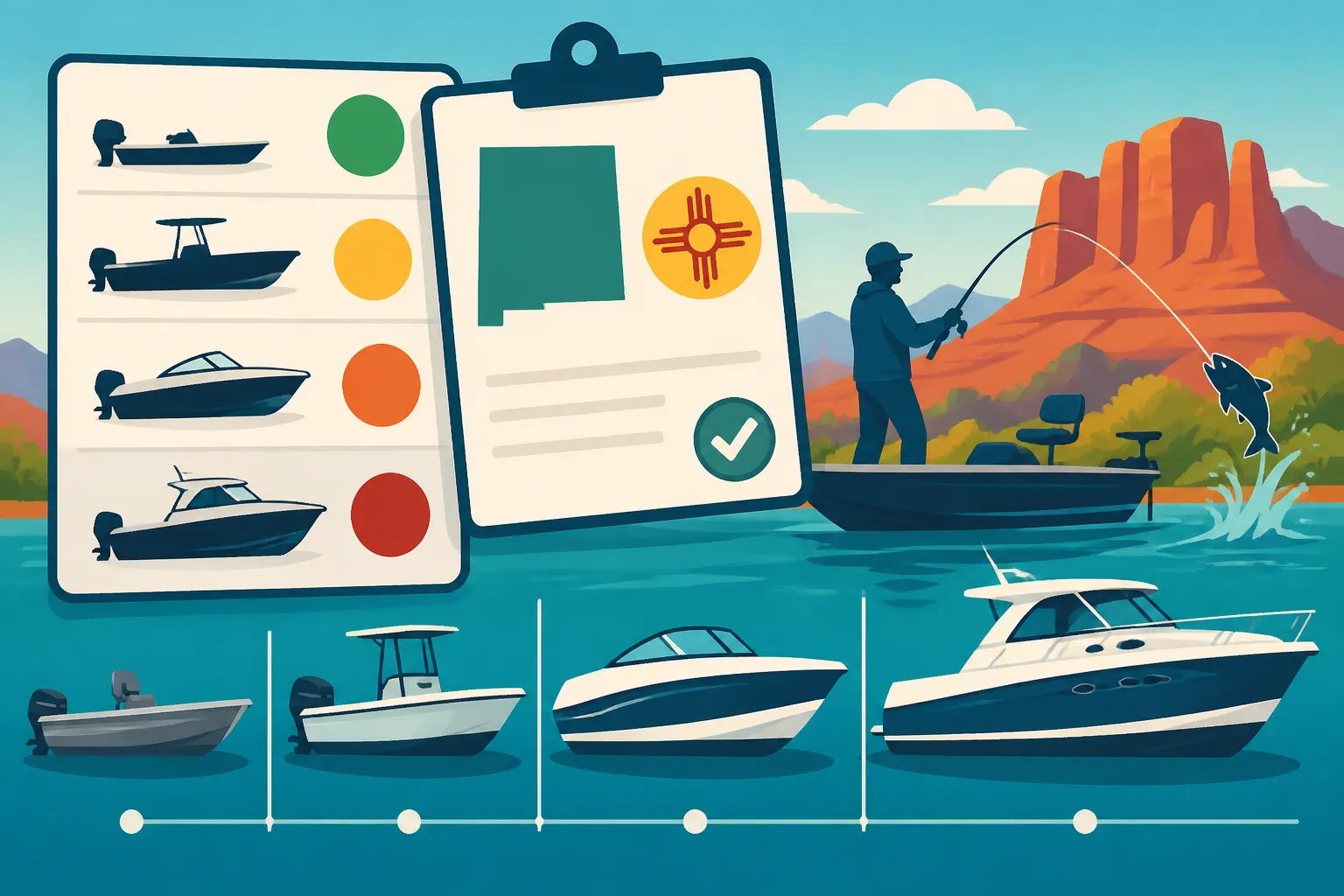
Alright, let's get down to brass tacks: the actual cost. New Mexico's boat registration fees are primarily determined by the length of your vessel. This is a common way for states to categorize fees, as larger boats generally have a greater impact on waterways and often require more infrastructure. Understanding these length classes and their associated costs is key to budgeting for your boating adventures.
Standard Annual Registration Fee Structure
The New Mexico MVD categorizes boats into several length classes, each with its own annual registration fee. These fees are generally for a one-year registration period, and you'll need to renew them annually. Keep in mind that these are the base registration fees; we'll talk about additional costs like titling and the Habitat Management and Access Validation (HMAV) later.
Here’s a quick overview of the standard fee structure for recreational boats in New Mexico:
| Boat Length (Feet) | Annual Registration Fee |
|---|---|
| Less than 16' | $23.00 |
| 16' to less than 20' | $29.00 |
| 20' to less than 26' | $35.00 |
| 26' to less than 40' | $47.00 |
| 40' and over | $59.00 |
It’s important to measure your boat accurately, from bow to stern, not including any detachable parts like swim platforms or bowsprits that extend beyond the main hull. A mistake in measurement could lead to incorrect fees or, worse, issues if you're ever stopped for a compliance check. You can see how even a small difference can shift you into a higher fee bracket.
Understanding the Length Classes and Their Costs
Let's break down these categories a bit more, because each one tends to represent a different type of boating experience, and thus, a different cost.
Less than 16 feet: This category typically includes smaller fishing boats, aluminum jon boats, inflatables with motors, and utility boats. These are often the workhorses for many anglers targeting crappie at Ute Lake or fishing the lower Rio Grande. The $23.00 annual fee is the most budget-friendly option, making it accessible for those just getting started or who prefer a more nimble craft. It’s also common for folks who have added small electric trolling motors to kayaks or canoes, pushing them into the registration requirement.
16 feet to less than 20 feet: This is a very popular size range for many recreational anglers and family boaters. Think bass boats, pontoon boats, and smaller runabouts perfect for enjoying Navajo Lake or Conchas Lake. At $29.00, it's a modest increase, but it's important for owners of these common vessels to know this is where they'll likely fall. Many people stepping up from a smaller boat find this category offers a good balance of space and maneuverability without a huge jump in registration cost.
20 feet to less than 26 feet: Here we're looking at larger pontoon boats, deeper V-hull fishing boats, and cuddy cabin boats. These are fantastic for the bigger waters like Elephant Butte Lake, especially when the wind picks up, or for longer excursions. The $35.00 fee reflects the increased size and capability. Owners of these boats often invest more in their vessels, so the registration fee is a relatively small part of their overall boating expenses, but it's still good to know what to expect.
26 feet to less than 40 feet: This category is for more substantial cruisers, large houseboats, or serious offshore-style fishing vessels. While New Mexico doesn't have an ocean, our large reservoirs can certainly accommodate these boats. The $47.00 fee aligns with the larger investment and greater operational requirements of such vessels. These boats are less common for casual day-tripping and more for extended stays or specialized activities.
40 feet and over: These are typically very large houseboats or custom vessels found on our biggest lakes. The $59.00 annual fee is the highest, acknowledging the considerable size and luxury of these boats. It's a relatively small portion of the overall cost of owning and operating such a large craft, but it ensures proper identification and regulation on the water.
Factors Influencing Your Total Registration Bill
While the boat's length is the primary determinant of the registration fee, your total bill at the MVD office might include a few other charges. It's really easy to overlook these until you're standing at the counter, so let's make sure you're prepared.
First off, nearly all boats that need to be registered also need to be titled in New Mexico. This is a one-time fee, separate from the annual registration, and it essentially establishes legal ownership, much like a car title. The cost for a title is currently $10.00. So, for a new boat owner, you'll pay the registration fee plus the titling fee in your first year. Make sure you understand the full New Mexico Boat Title Fee before heading to the MVD.
Secondly, there might be transaction fees, especially if you're using a third-party vendor rather than a direct MVD office. These are usually small but can add up. Finally, if you're registering your boat late or renewing past the deadline, you could incur late penalties. These are designed to encourage timely registration and can be avoided by simply staying on top of your renewal dates. Keep an eye on the expiration date, which aligns with the last day of the month you originally registered your boat.
Additional Fees and Requirements Beyond Basic Registration
It would be too easy if boat registration was just one simple fee, right? Unfortunately, like many bureaucratic processes, there are a few other stamps, validations, and fees that might come into play. It’s crucial to know about these so you’re not caught off guard and can ensure full compliance while enjoying New Mexico's waters.
The New Mexico Boat Titling Process and Fees
As I mentioned before, if your boat needs to be registered, it almost certainly needs to be titled. The title is the official document proving ownership, and it’s a one-time process for each owner. When you buy a new boat, or a used one, you'll need to transfer the title into your name. This typically happens at the same time you register it for the first time.
The fee for a boat title in New Mexico is a flat $10.00. This is paid directly to the MVD. You'll need proof of ownership, like a manufacturer's statement of origin (MSO) for a new boat or a properly assigned title from the previous owner for a used boat. Having all your paperwork in order for the title transfer will make the whole process much smoother. It's also important to note that you generally have a specific timeframe to title and register a boat after purchasing it. For new purchases, you typically have 30 days from the date of purchase to complete the process. Failing to do so can result in penalties. Remember, titling is distinct from registration, but they often go hand-in-hand to establish both legal ownership and the right to operate on public waters.
Understanding the Habitat Management and Access Validation
Here’s another fee that often causes a little head-scratching, especially for those who primarily think about fishing licenses. The Habitat Management and Access Validation (HMAV), sometimes informally called a "Habitat Stamp," is a mandatory fee for anyone 18 years or older who participates in hunting, fishing, or trapping activities on lands or waters administered by the NMDGF, or other federal lands (like National Forests or BLM lands) where the NMDGF has a cooperative agreement.
While it's not directly part of the boat registration fee, it's absolutely something boaters who also fish will need. Most anglers purchase this alongside their annual fishing license. The current cost is typically around $4.00 for residents and $4.00 for non-residents, though exact fees can change slightly year to year. You can purchase this validation when you get your New Mexico Fishing License Guide or through the NMDGF website or vendors. Even if you're just using your boat to get to a fishing spot on designated lands, you'll need this validation. So, don't forget to factor this small but important cost into your overall expenses, especially if you plan on casting a line from your vessel.
Renewal Fees and Late Penalties
Once you’ve successfully registered your boat, you’ll need to remember that it’s not a one-and-done deal. New Mexico boat registrations are valid for one year from the date of issuance. So, if you register your boat in June, it will expire the following June. It's usually a good idea to mark your calendar or set a reminder. The MVD generally doesn't send out paper renewal notices anymore, so the responsibility is on you to remember.
Renewal fees are typically the same as the initial annual registration fee for your boat's length class. So, if you paid $29.00 for your 18-foot boat, you'll pay $29.00 to renew it. If you forget or simply don't get around to renewing on time, you could be subject to late penalties. These penalties can vary but generally involve an additional fee on top of your renewal cost. Furthermore, operating an unregistered or expired-registration boat can lead to fines if you're stopped by Game and Fish wardens or MVD officers. It’s always cheaper and less stressful to renew on time! You can often renew your registration online, which makes the process very convenient.
How to Register Your Boat in New Mexico
Now that we've covered the "why" and the "how much," let's talk about the "how to." Getting your boat registered in New Mexico isn't overly complicated, but knowing the steps and what documents you'll need upfront can save you a ton of time and frustration. Whether you prefer the convenience of online services or the direct interaction of an in-person visit, both options are available.
Step-by-Step Online Registration Process
For many people today, the internet is king, and thankfully, New Mexico offers an online portal for boat registration, particularly for renewals and some initial registrations. The MVD’s online services portal is typically where you’ll start.
- Gather Your Information: Before you log in, make sure you have all the necessary details at hand. This includes your boat's Hull Identification Number (HIN), make, model, year, length, and engine details (make, horsepower). If you're renewing, you'll need your current registration number.
- Access the MVD Online Portal: Head to the official New Mexico MVD website. Look for sections related to "Online Services" or "Boat Registration."
- Create or Log In to Your Account: If you don't have an MVD online account, you'll need to create one. This usually involves providing some personal identification details.
- Initiate Registration/Renewal: Follow the prompts to either begin a new boat registration or renew an existing one. You’ll input all the boat's details, your personal information, and confirm the length class.
- Pay the Fees: The system will calculate your total fees based on your boat's length and any other applicable charges (like titling, if it's a new registration). You can pay securely with a credit or debit card.
- Print Temporary Documentation: Once complete, you’ll usually be able to print a temporary registration document. Your official decals and registration card will then be mailed to you, which typically takes a few weeks. Remember, until those arrive, carry your temporary document when boating!
- Apply Decals: When your permanent decals arrive, apply them to your boat according to New Mexico Game and Fish regulations. This usually means displaying the registration numbers on each side of the bow, and the current year decal near the numbers.
For more details, you can look up Buying a New Mexico Fishing License Online for a similar process that outlines digital transactions with the state.
Registering In-Person at MVD Offices or Vendors
If you prefer a more traditional approach, or if your situation is a bit complex (like a new purchase with a title transfer from out of state), an in-person visit to an MVD office or an authorized third-party vendor is often the best route.
- Locate an MVD Office or Vendor: Find the nearest New Mexico MVD office or one of their authorized third-party service providers. You can usually do this through the MVD website.
- Gather Required Documents: This is the most crucial step for an in-person visit. You'll need:
- Proof of Ownership: This could be a manufacturer's statement of origin (MSO) for a new boat, a properly signed-over title from the previous owner (for used boats), or a bill of sale along with a previous registration if a title isn't available (though this varies by circumstance).
- Photo ID: Your valid driver's license or state ID.
- Proof of New Mexico Residency: If applying for resident rates, though often your driver's license suffices.
- Completed Application Form: You can often download this from the MVD website beforehand and fill it out to save time.
- Payment: Be prepared to pay with cash, check, or credit/debit card.
- Visit the Office: Go during business hours, preferably avoiding peak times. Be prepared for a wait, as MVD offices can get busy.
- Submit Paperwork and Pay Fees: The MVD agent will review your documents, verify your boat's details, and calculate your fees. Once paid, they will issue you a temporary registration and often provide you with your permanent decals and registration card on the spot.
This method allows for immediate clarification of any questions and instant issuance of permanent documents, which some people find less stressful than waiting for mail. For more information on where you can complete these transactions, check out Where to Buy a New Mexico Fishing License in Person for a list of vendors and offices that often handle boat registration too.
Required Documentation for Boat Registration
Whether you're registering online or in person, having all your ducks in a row with documentation is critical. Missing one piece of paper can lead to frustrating delays. Here’s a detailed list of what you'll typically need:
- For a New Boat Purchase:
- Manufacturer’s Statement of Origin (MSO): This is the "birth certificate" for your boat, indicating it's new and has never been titled or registered.
- Bill of Sale: A detailed receipt showing purchase price, date, and seller's information.
- For a Used Boat Purchase (from New Mexico or another state):
- Properly Assigned Title: The previous owner's title, signed over to you. This is essential for proving ownership.
- Bill of Sale: Again, a detailed document of the transaction.
- Current Registration (if available): While the title is paramount, a current registration can help verify details and make the process smoother.
- For Any Registration:
- Proof of Identity: A valid driver's license, state ID, or other government-issued photo ID.
- Hull Identification Number (HIN): This unique 12-digit number is typically found on the transom (the back) of your boat, usually on the starboard (right) side. It's like your boat's VIN.
- Engine Information: Make, model, serial number, and horsepower of all motors (outboard, inboard, electric).
- Boat Specifications: Make, model, year, and precise length of the vessel.
- Application Form: The official MVD boat registration application, filled out completely.
- Payment for Fees: The total amount for registration, titling (if applicable), and any other associated fees.
Always double-check the MVD website or call ahead to confirm the exact documents required for your specific situation, as requirements can sometimes change or have slight variations based on the transaction type.
Important Considerations and Common Mistakes
Even with all the information laid out, there are still a few common pitfalls and special situations that can trip up boat owners. Being aware of these can save you a headache (and potentially a fine!) down the line. It's all about being prepared and understanding the nuances of the system.
Grace Periods and Transferring Ownership
When you purchase a new or used boat, there's typically a grace period during which you can legally operate it while you complete the registration process. In New Mexico, you generally have 30 days from the date of purchase to title and register your boat. This grace period is not an excuse to delay the process, but rather a short window to allow you to get all your paperwork in order and visit the MVD. Operating beyond this 30-day window without a valid registration can result in fines.
Transferring ownership is a key part of this process. When buying a used boat, ensure the previous owner properly signs over the title to you. Without a correctly assigned title, you won't be able to register the boat in your name. This is a common mistake for private sales – sellers might provide just a bill of sale, but the title is the legally binding proof of ownership transfer. Always demand a properly signed title. If the previous owner doesn't have one, or there are issues with it, be very cautious, as you might inherit a boat you can't legally register. For more on this, check out Transferring a Boat Registration to a New Owner in New Mexico.
Penalties for Unregistered Boats
Operating an unregistered or improperly registered vessel in New Mexico is a violation of state law, and there are consequences. These penalties are designed to deter non-compliance and ensure everyone on the water is accounted for and contributing to the system.
If you're stopped by a New Mexico Game and Fish warden or MVD officer and your boat is found to be unregistered, expired, or lacking proper display of numbers/decals, you could face fines. The exact amount of the fine can vary depending on the severity of the violation and whether it's a first offense. Generally, these fines can range from a few dozen dollars to several hundred dollars, plus court costs in some cases. It's significantly more expensive than simply paying the annual registration fee on time. Beyond the monetary penalties, officers may also require you to remove your boat from the water until it is properly registered, which can certainly put a damper on your fishing trip! Make sure you know the full Penalty for Fishing Without a License in New Mexico as well, which is another common violation on the water.
Special Cases: Kayaks, Canoes, and Trolling Motors
We touched on this briefly, but it's worth emphasizing, as it's a frequent point of confusion for many outdoor enthusiasts. Non-motorized vessels like canoes, kayaks, stand-up paddleboards, and rafts do not require registration in New Mexico. This is excellent news for those who enjoy silent sports on our lakes and rivers.
However, the moment you attach any motor, even a small electric trolling motor, to one of these vessels, it transforms it into a "motorboat" under New Mexico law, and thus, it must be registered. This includes even the most modest of electric motors. So, if you've got a fishing kayak and want to add that little electric push to cover more water at places like Cochiti Lake, remember you'll need to register that kayak (and likely title it too). This also means you'll need to display the registration numbers and decals on your kayak, which sometimes requires a bit of creativity to ensure they are properly visible. It’s a common misconception that a small electric motor is exempt, but that’s not the case here in New Mexico. So, plan accordingly! You can find more specific guidance on Do Electric Trolling Motors Need Registration in New Mexico? if you're exploring that option.
Disclaimer
The information provided in this guide is for general informational purposes only and does not constitute legal advice. While we strive to keep the information up-to-date and correct, rules and regulations regarding New Mexico boat registration, titling, and associated fees can change. Always consult the official New Mexico Motor Vehicle Division (MVD) and New Mexico Department of Game and Fish (NMDGF) websites or contact them directly for the most current and accurate information relevant to your specific situation.