What a Tiger Muskie Is
You've likely heard whispers of the "Tiger Muskie" if you're an angler in New Mexico, and maybe even seen a blurry photo of a monstrous fish with a menacing maw. It's a name that conjures images of powerful, elusive predators, and often leaves many folks wondering: what exactly is this creature, and how did it end up in our high desert waters? This guide is here to unravel the mystery, providing a deep dive into the fascinating world of the Tiger Muskie, its unique characteristics, and why it plays such an important role in our state's fisheries.
The Hybrid Hunter: What Exactly is a Tiger Muskie?
The Tiger Muskie isn't a naturally occurring species in the wild. It's actually a fascinating hybrid, a crossbreed created when two other formidable freshwater predators get together. Understanding its origins is key to appreciating this unique fish and why New Mexico's fisheries department has a special place for it.
A Tale of Two Species: Pike and Muskie
At its core, a Tiger Muskie is the offspring of a Northern Pike ( Esox lucius) and a Muskellunge (Esox masquinongy). Think of it like a mule in the animal kingdom – a sterile hybrid born from two distinct but related species. This cross isn't something that typically happens naturally in the wild with any regularity, as their spawning times and preferred habitats don't often overlap perfectly. However, fisheries biologists figured out that by artificially spawning these two giants, they could create a truly unique fish.
The result is what's known as "hybrid vigor," meaning the Tiger Muskie often grows faster and is more aggressive than either of its parent species. It combines the lean, torpedo-like body and predatory instinct of the Northern Pike with the larger size potential and elusive nature of the Muskellunge. Because they are sterile, these fish cannot reproduce on their own, which is actually a crucial element in New Mexico's stocking strategy. This sterility means that fisheries managers have complete control over their population numbers, preventing them from overrunning an ecosystem.
Physical Characteristics: Identifying a Tiger
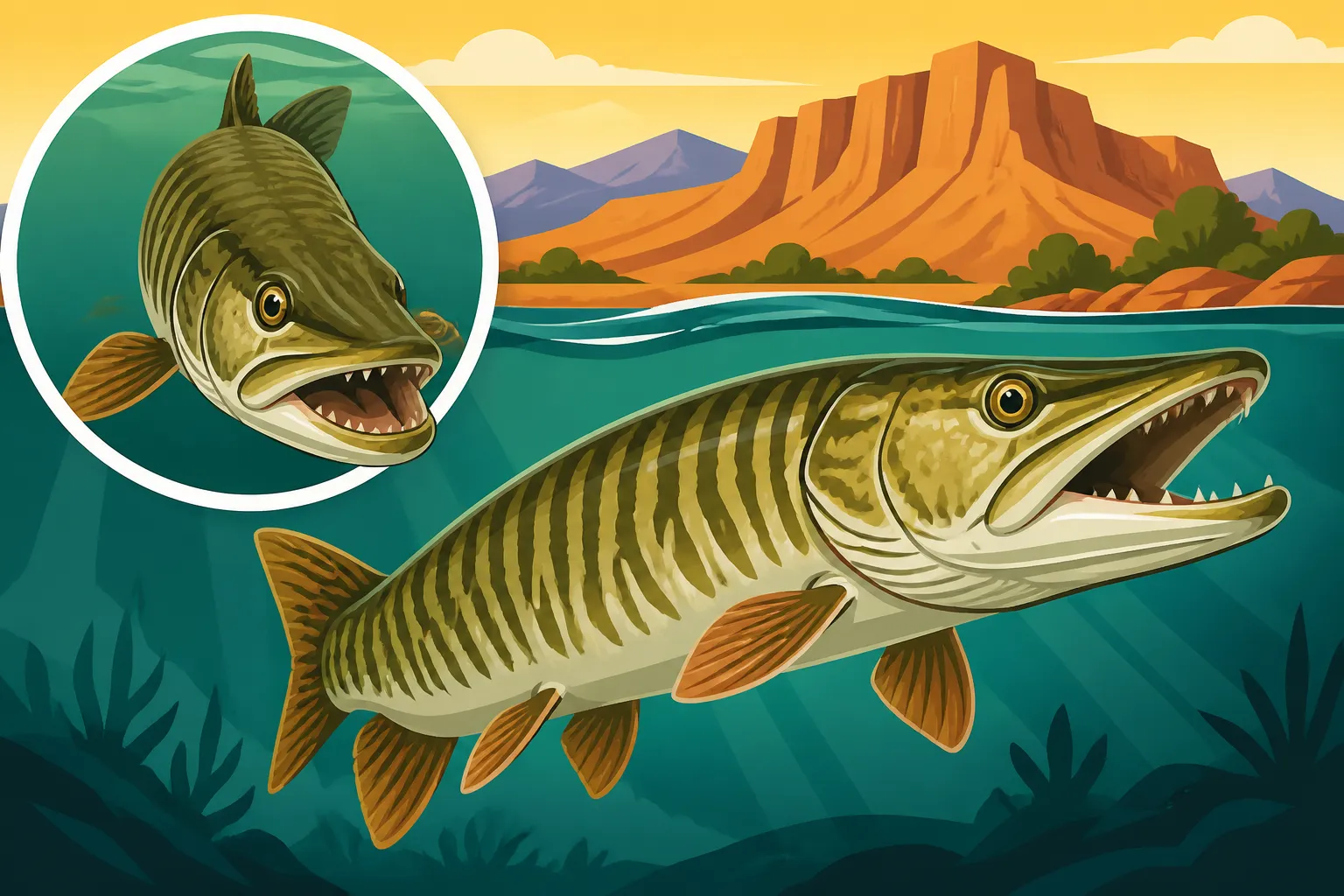
When you pull a Tiger Muskie from the water, you'll immediately understand where it gets its name. While Northern Pike have distinct bean-shaped spots and Muskellunge usually have spots or bars, the Tiger Muskie displays a striking pattern of dark, vertical bars or wavy, tiger-like stripes on a lighter background. This distinctive camouflage helps them blend into rocky shorelines, weed beds, or submerged timber, waiting to ambush their prey.
Their body shape is long and cylindrical, built for explosive speed, much like a torpedo. They possess a large, duckbill-shaped mouth armed with a terrifying array of sharp, needle-like teeth, perfectly adapted for grasping and holding onto slippery prey. The dorsal and anal fins are located far back on their body, close to their powerful tail, which is another adaptation for quick bursts of speed. While pure Muskellunge can grow to truly enormous sizes in their native range, and Northern Pike can also be quite large, Tiger Muskies in New Mexico tend to reach impressive sizes, often growing bigger than the typical pike found here, though perhaps not quite to the maximum size of a true muskellunge. If you're wondering about Tiger Muskie Size at Bluewater Lake, you'll find they offer a thrilling challenge.
Here's a quick comparison of the three species:
| Feature | Northern Pike | Muskellunge | Tiger Muskie (Hybrid) |
|---|---|---|---|
| Parentage | Pure species | Pure species | Northern Pike x Muskellunge |
| Fertility | Fertile, reproduces naturally | Fertile, reproduces naturally | Sterile, cannot reproduce |
| Markings | Light, bean-shaped spots on dark body | Dark spots/bars on light body; highly variable | Distinct dark, wavy stripes/bars on light body |
| Cheek Scales | Fully scaled cheek | Upper half of cheek scaled | Fully scaled cheek (like pike parent) |
| Tail Shape | Rounded/slightly forked | Deeply forked | Slightly forked to rounded |
| General Growth | Moderate growth, good fighting fish | Slow growth, reaches largest sizes | Fast growth, aggressive, reaches large size |
Why Tiger Muskies in New Mexico? The Management Story
New Mexico is known for its stunning landscapes, and while trout often steal the spotlight, the state's diverse fisheries management has a smart reason for introducing these striped predators into certain waters. It's not just about adding another cool fish to catch; it's a strategic move to improve the overall health of specific lake ecosystems.
A Predator's Role: Controlling Unwanted Fish
The primary reason New Mexico Game and Fish decided to stock Tiger Muskies, as detailed in Why New Mexico Stocked Tiger Muskies in Its Lakes, is for their exceptional ability to control populations of unwanted or overabundant fish species. Many of our reservoirs, like those across the country, can develop issues with stunted panfish or prolific rough fish like carp and white suckers. These fish compete with more desirable game species for food and habitat, often leading to an imbalanced ecosystem where no fish really thrives.
Enter the Tiger Muskie. Their voracious appetite and aggressive predatory nature make them incredibly effective biological vacuum cleaners. They will actively hunt and consume large numbers of these nuisance fish, reducing competition and allowing species like trout, bass, and walleye to grow larger and healthier. Because Tiger Muskies are sterile, they won't overpopulate and create a new problem. This allows fisheries managers to precisely control how many are in a given lake, fine-tuning the predator-prey balance. It’s a very targeted, efficient method of ecosystem management that avoids the use of chemicals or other more intrusive methods.
Where They Thrive: New Mexico's Tiger Muskie Lakes
While Tiger Muskies aren't found in every lake across New Mexico, they have been strategically placed in specific waters where their predatory services are most needed and where they have the best chance to thrive. The most well-known stronghold for Tiger Muskies in New Mexico is undoubtedly Bluewater Lake Fishing, located west of Grants. This lake has developed a reputation for producing some truly impressive specimens.
Beyond Bluewater, you might also find them in other waters that are susceptible to overpopulation by forage fish or have large populations of stunted panfish. These lakes typically offer a good mix of deeper water, submerged structure like timber or rock piles, and ample weed beds (when water levels allow) which provide excellent ambush points for these stealthy predators. Anglers targeting these waters should research the specific lake they plan to visit to confirm current stocking and habitat conditions. Understanding the general New Mexico Fishing Regulations Overview will always be your first step before heading out to any of these waters.
Fishing for Tiger Muskies: The Thrill of the Chase
Chasing Tiger Muskies isn't for the faint of heart or the impatient. These fish are often called the "fish of a thousand casts" for a reason – they are notoriously challenging to catch, but when you do, the fight is unforgettable. It's a game of strategy, perseverance, and having the right tools for the job.
Gear Up: Tackle for the Toothiest Fish
Because Tiger Muskies grow large and possess an impressive set of teeth, your typical trout or bass gear simply won't cut it. You need heavy-duty tackle designed to handle powerful strikes and keep those sharp teeth from severing your line. When it comes to rods, think stiff, fast-action baitcasting rods, often in the 7 to 9-foot range. A specific Best Rod Power for Tiger Muskie Fishing is often a medium-heavy to heavy power, capable of launching large lures and muscling in big fish. Pair this with a robust baitcasting reel spooled with strong braided line, at least 50-80 pound test.
The most critical piece of equipment, however, is your leader. Given those razor-sharp teeth, a steel or heavy fluorocarbon leader is absolutely non-negotiable to prevent bite-offs. If you're asking Do You Need Steel Leader for Tiger Muskie?, the answer is an emphatic yes. Many anglers find a visit to online retailers like Amazon helpful for comparing a wide range of specialized muskie leaders, lures, and other robust gear. Lures themselves need to be substantial: large spinnerbaits, bucktails, crankbaits, jerkbaits, and big swimbaits are standard fare. Carrying long-nose pliers and a jaw spreader is also crucial, not just for removing hooks but for safely handling the fish without getting bit.
Techniques and Strategies: Patience is Key
Tiger Muskie fishing demands patience and persistence. These fish are ambush predators, so you're often looking for them near structure: weed lines, submerged timber, rock piles, sudden drop-offs, or points. Casting and retrieving large lures along these structures is a common approach. Vary your retrieve speed and incorporate pauses and jerks to entice a strike. Sometimes, a "figure eight" at the side of the boat, tracing your lure in a large "8" pattern before lifting it from the water, can trigger a follow-up strike from a hesitant fish.
Trolling with large crankbaits or swimbaits is another effective method, especially in larger lakes like Bluewater, allowing you to cover more water and target different depths. Pay close attention to your electronics to locate submerged structures or schools of baitfish, which often indicate muskie presence. Remember, they are often solitary hunters, so you might go hours without a bite, but when that strike comes, it's usually explosive and unforgettable. The adrenaline rush alone is worth the wait, but the patience required is truly a test of an angler's mettle.
Conservation and Regulations: Protecting New Mexico's Tigers
While Tiger Muskies are stocked for management purposes, they are still a prized game fish. Due to their unique role and the effort involved in raising and stocking them, New Mexico has specific regulations in place to ensure their populations remain healthy and continue to benefit the ecosystem. Respecting these rules and practicing proper handling techniques are paramount.
Bag Limits and Special Rules
Like all game fish in New Mexico, Tiger Muskies are subject to specific bag and possession limits, and often size restrictions. These regulations are designed to manage the population for both ecological benefit and angling opportunity. For example, some lakes might have a slot limit, meaning fish within a certain size range must be immediately released, while smaller or larger fish might be legal to keep. This helps protect the breeding stock (though Tiger Muskies are sterile, the principle applies to maintaining a healthy population of predators) and allows fish to reach trophy sizes.
It's absolutely vital to consult the current New Mexico Fishing Regulations Overview or the New Mexico Department of Game and Fish website before heading out. Regulations can change, and specific rules often apply to individual lakes. Failing to know and follow these rules can result in significant penalties. Most serious muskie anglers practice catch-and-release, aiming to enjoy the fight and then return these incredible fish to the water to grow even larger for another day.
Handling and Releasing: A Fish's Best Chance
Because Tiger Muskies are such powerful fish with sharp teeth and can be quite large, proper handling is crucial for both the angler's safety and the fish's survival, especially if you intend to release it. Always minimize the time the fish spends out of the water. Long-nose pliers or a specialized hook remover are essential for quickly and safely extracting hooks. A jaw spreader can be helpful, but use it with extreme caution to avoid injuring the fish's mouth.
When holding a muskie for a quick photo, support its body horizontally with one hand under its belly and the other gently gripping its tail, or hold it vertically by the gill plate if you know the proper technique. Avoid handling them by the eye sockets or gill rakers, as this can cause severe damage. Catch and Release Best Practices in New Mexico emphasize that quick, careful handling greatly increases a fish's chances of survival. Lower the fish gently back into the water, headfirst, and hold it until it swims away under its own power. Sometimes, gently moving it back and forth to force water over its gills can help revive it before release. Treat these striped fighters with respect, and they'll continue to provide thrilling challenges for years to come.
Disclaimer
This article is for general informational purposes only and does not constitute professional advice. Laws, prices and regulations vary by location and change over time. Consult a qualified professional for guidance on your specific situation.