How to Fish a Texas Rig for New Mexico Bass
There's nothing quite as frustrating as casting your lure into a promising-looking stretch of water, only to have it snagged on submerged brush, rocks, or weeds seconds later. New Mexico's diverse lakes and rivers, with their varying levels of cover and structure, can make bass fishing a real challenge for anglers. This comprehensive guide is here to unravel the mystery of the Texas rig, showing you exactly how this versatile setup can drastically improve your success rate for catching bass in the Land of Enchantment.
Understanding the Texas Rig Advantage for New Mexico Bass
The Texas rig isn't just another way to present a soft plastic bait; it's a revolutionary approach that excels in conditions where other rigs fail. Born out of necessity in areas with heavy cover, it has become an indispensable tool for bass anglers across the country, and especially here in New Mexico. Its genius lies in its simplicity and its incredible weedless nature, allowing your bait to slip through snags that would hang up a traditional jig or exposed hook setup.
Why New Mexico's Diverse Waters Demand It
New Mexico's bass fisheries are incredibly varied. You might be fishing a clear, rocky reservoir like Elephant Butte Lake one day, and a brush-filled, murky cove at Conchas Lake the next. Or perhaps you're targeting smallmouth bass in the rocky stretches of Abiquiu Lake. What all these diverse environments often have in common is challenging underwater structure – submerged trees, rock piles, thick vegetation, or patchy weeds. A standard jig or spinnerbait can get hopelessly snagged almost immediately, leading to lost lures and wasted time.
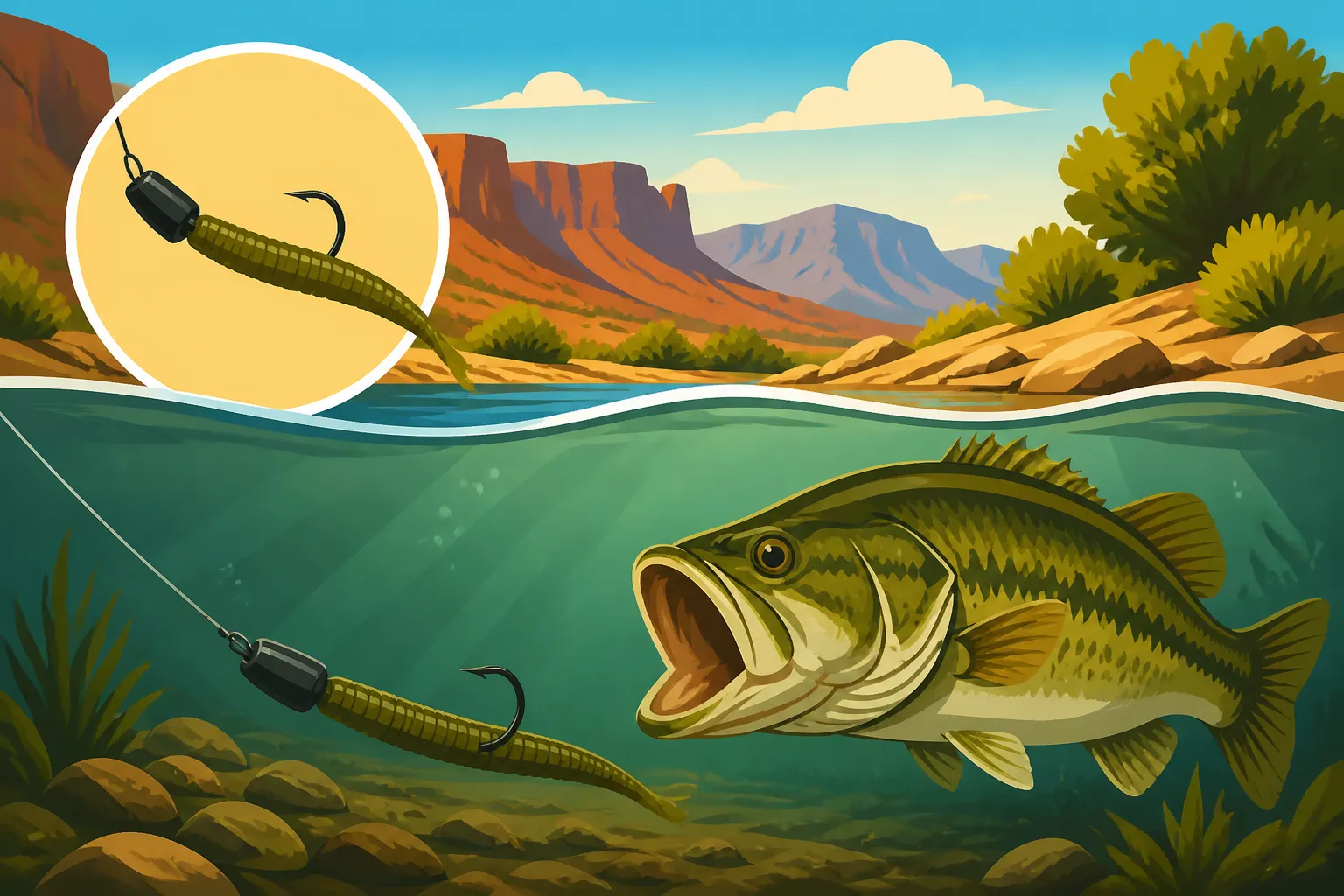
This is where the Texas rig shines. Its design, with the hook point embedded in the soft plastic bait, allows it to glide over and through obstacles with minimal hang-ups. Imagine working your bait slowly along a rocky bottom, bumping over boulders and logs, without fear of losing your prized lure. Or pitching it deep into a sunken mesquite bush where a big largemouth is hiding, knowing it will come out clean. This ability to fish effectively in heavy cover means you can present your bait where the biggest bass are often found – tucked away, waiting to ambush prey. It’s about getting your lure into places that would be unfishable with other methods, giving you a distinct advantage.
Common Bass Species Targeted
While the Texas rig is effective for a variety of species, it truly shines when targeting New Mexico's popular bass populations. The primary targets for this rig are both largemouth and smallmouth bass.
- Largemouth Bass: These are often found in warmer, shallower waters with plenty of cover like hydrilla, cattails, fallen timber, and brush. Lakes like Elephant Butte, Conchas, and Ute Lake are prime largemouth country. The Texas rig allows you to penetrate this heavy cover, reaching the big fish that are hunkered down. A bulky creature bait or a long worm on a Texas rig can mimic their natural prey perfectly, enticing a strike from a territorial largemouth hiding deep in the weeds.
- Smallmouth Bass: Smallmouths prefer clearer, cooler water with rocky bottoms, gravel, and rip-rap. Abiquiu Lake and Navajo Lake offer excellent smallmouth opportunities. While not as prone to dense vegetation, smallmouths still relate heavily to rock piles, ledges, and submerged timber. The weedless nature of the Texas rig means you can drag a worm or crawfish imitation right through these rocky crevices without getting stuck, presenting a tempting meal to a wary smallmouth.
By understanding the habits of both largemouth bass and smallmouth bass, you can adapt your Texas rig presentation to match their preferred habitat and feeding behaviors, maximizing your chances of a successful day on the water.
Essential Components: Building Your New Mexico Texas Rig
Building a successful Texas rig isn't just about putting a hook and weight on a line; it's about selecting the right components that work together for the specific conditions you're fishing in New Mexico. Each part plays a crucial role in the rig's performance, from its ability to penetrate cover to how it presents your bait.
Hook Selection for Optimal Hook-Set and Weedlessness
The hook is arguably the most critical component of your Texas rig. You need a hook that is strong enough to handle a hard-fighting bass, sharp enough for a quick penetration, and designed to minimize snags while maximizing hook-up ratios.
- Extra-Wide Gap (EWG) Hooks: These are the most common and popular choice for Texas rigs, and for good reason. The wide gap allows for plenty of space between the hook point and the shank, which is essential when fishing bulky soft plastics. When a bass bites down, the plastic compresses, and the wide gap ensures the hook point has room to clear the plastic and penetrate the fish's mouth. Brands like Gamakatsu and Owner make excellent EWG hooks that you can find on Amazon.
- Straight Shank Hooks: While less common for beginners, straight shank hooks can offer a better hook-up ratio in certain situations, particularly when fishing worms in lighter cover. They have a shorter gap, which means less plastic to clear on the hook-set, but they are more prone to snagging in heavy vegetation.
- Hook Size: Your hook size needs to match the size of your soft plastic bait. A good rule of thumb is that the hook point should exit the plastic roughly halfway down its body, allowing for good exposure on the hook-set.
- For 4-5 inch worms or smaller creature baits, a 2/0 or 3/0 EWG hook is usually perfect.
- For 6-8 inch worms or larger creature baits, step up to a 4/0 or 5/0 EWG hook.
- For truly massive 10+ inch worms or big swimbaits, you might even need a 6/0 or larger.
Remember, a sharp hook is a must. Always check your hook point periodically, especially after dragging it through rocky or brushy areas.
Weight Choices: Tungsten vs. Lead and When to Use Which
The weight on your Texas rig dictates how fast your bait falls, how it feels on the retrieve, and its ability to punch through cover. Conical bullet weights are standard, as their shape helps the rig slide through snags.
- Tungsten Weights: Tungsten has become the preferred choice for serious bass anglers, and for good reason. It is significantly denser than lead, meaning a tungsten weight of the same ounce is much smaller in profile than its lead counterpart. This smaller size allows for better penetration through heavy cover (think punching through thick mats of hydrilla or dense brush piles). Additionally, tungsten is much harder than lead, providing superior sensitivity. You can feel every subtle bump, rock, or change in bottom composition, which is crucial for detecting light bites. While more expensive, the sensitivity and cover-penetrating ability often make them worth the investment, especially when you're trying to feel for those nuanced bites that can be tough to detect. You can find various tungsten weights on Amazon from brands like WOO! Tungsten or Ark.
- Lead Weights: Lead weights are a more affordable and readily available option. They work perfectly fine in many situations, especially in sparser cover or open water. However, they are larger in profile and less sensitive. If you're just starting out or fishing less challenging cover, lead weights are a great way to go.
- Weight Selection by Depth and Cover:
- 1/8 oz to 1/4 oz: Ideal for shallow water (under 8 feet), sparse cover, or when you want a slower, more natural fall for your bait.
- 3/8 oz to 1/2 oz: This is your workhorse range, good for moderate depths (8-15 feet) and general cover conditions. It provides a good balance of fall rate and feel.
- 3/4 oz to 1 oz+: When you need to get deep fast (15+ feet), or punch through really heavy cover like thick vegetation mats or dense submerged brush. These heavier weights are essential for reaching fish holding tight in the thickest stuff.
Line and Rod/Reel Considerations for Heavy Cover
Your rod, reel, and line work in tandem to provide the power and sensitivity needed to fish a Texas rig effectively, especially in the rugged environments New Mexico offers.
- Fishing Line:
- Fluorocarbon (12-20 lb test): This is generally the best all-around choice for Texas rigging. Fluorocarbon is nearly invisible underwater, offers excellent sensitivity, and has low stretch for strong hook-sets. Its abrasion resistance is also a huge plus when fishing around rocks and wood.
- Braided Line (30-65 lb test) with Fluorocarbon Leader: For extremely heavy cover situations (e.g., punching through dense mats), braided line is superior due to its zero stretch and incredible abrasion resistance. However, since braid is highly visible, tie on a 15-20 lb fluorocarbon leader (2-3 feet long) for stealth. This setup gives you the best of both worlds.
- Rod: You'll want a casting rod with a fast action and medium-heavy to heavy power.
- Fast Action: This means the rod bends mostly in the tip section, allowing for sensitive feel and quick, powerful hook-sets.
- Medium-Heavy to Heavy Power: This provides the backbone needed to drive a heavy hook through plastic and into a bass's mouth, and to winch fish out of heavy cover. A 7' to 7'6" rod length is a good general choice, offering casting distance and leverage. For pitching and flipping into tight spots, a slightly shorter rod (6'8" to 7') can be advantageous. For specific recommendations, check out a guide on fishing rods and reels and adapt the power for bass.
- Reel: A baitcasting reel with a gear ratio between 6.4:1 and 7.5:1 is ideal. The higher ratios allow you to quickly take up slack line, which is critical for strong hook-sets and staying in contact with your bait. Look for a reel with a smooth, powerful drag system, as you'll be fighting fish in close quarters.
Step-by-Step Rigging for Flawless Presentations
The beauty of the Texas rig lies in its simplicity, but executing the rigging correctly is key to its weedless properties and effective presentation. Take your time with these steps, and you'll soon be rigging them up instinctively.
Rigging Soft Plastics: The Art of Weedless Perfection
This is the standard, most effective method for rigging almost any soft plastic worm or creature bait on a Texas rig.
- Insert the Hook Point: Take your chosen soft plastic bait. Insert the point of your EWG hook (or straight shank hook) into the very top center of the bait, just enough to bury the barb.
- Thread the Bait: Push the hook point through about a quarter to half an inch of the plastic. Then, bring the hook point out of the side of the bait.
- Slide the Bait Up: Now, slide the bait up the shank of the hook, over the eye, and onto the line tie. The goal is to get the head of the plastic snugly against the eye of the hook, ensuring it's straight and doesn't twist. This prevents the bait from sliding down on casts or when a fish strikes, keeping your presentation clean.
- Measure and Re-Insert: Hold the bait alongside the hook to determine where the hook point should re-enter the plastic for a completely straight, weedless presentation. You want the bait to lay straight along the hook, not bunched up or stretched out.
- Bury the Hook Point: Once you've found the spot, rotate the hook 180 degrees so the point is facing the body of the plastic. Push the hook point directly into the belly of the bait. Make sure the point and barb are completely embedded within the plastic, making the rig virtually snag-proof.
- Check for Straightness: Give the bait a little shake. It should hang straight without any kinks or twists. If it's not straight, it won't have a natural action in the water and can cause line twist. Adjust as needed.
This "skin-hooked" method ensures maximum weedlessness. When a fish bites, the plastic compresses, exposing the hook point for a solid hook-set.
Pegging vs. Unpegging Your Weight: Tactical Decisions
The bullet weight on your Texas rig can either be "pegged" (fixed in place) or "unpegged" (free to slide up and down your line). Each method has its advantages for specific New Mexico fishing scenarios.
- Pegging Your Weight:
- How to Peg: You can peg your weight using a small rubber bobber stop, a toothpcik, or a specific pegging system (many tungsten weights come with pegging devices or have a hole for one). Slide the bobber stop or toothpick into the weight's opening, jamming it against your line just above the weight.
- When to Peg: Pegging is crucial when fishing in heavy cover. If your weight isn't pegged, it can slide down your line when it hits a branch or thick weed, leaving your hook exposed to snag. Pegging keeps the weight and hook together as one unit, allowing it to penetrate cover more effectively and maintain its weedless profile. This is essential for punching through vegetation mats at spots like Ute Lake or probing dense brush piles at Elephant Butte.
- Advantages: Better weed penetration, prevents the bait from separating from the weight, maintains a compact profile.
- Unpegging Your Weight:
- How to Unpeg: Simply tie your line directly to your hook, and slide your bullet weight onto the line before tying the hook. The weight will be free to slide up and down your line.
- When to Unpeg: Unpegged weights are excellent for fishing more open areas, sparse cover, or when you want a more natural, subtle presentation. When the unpegged weight hits the bottom, the soft plastic bait continues to fall slowly, creating a separation effect that mimics a fleeing or struggling creature. This subtle action can be incredibly enticing to finicky bass. It's also useful when fishing ledges or drops, as the weight falls first, and the bait slowly follows, giving bass more time to react.
- Advantages: More natural bait action, can entice hesitant bites, weight hitting the bottom can create a "thump" that attracts fish while the bait continues to fall freely.
Knowing whether to peg or unpeg your weight is a tactical decision that can significantly impact your success based on the cover, depth, and the activity level of the bass. For the diverse conditions of New Mexico, carrying pegging stops in your tackle box is a smart move.
Mastering the Retrieve and Presentations for New Mexico Bass Success
Once your Texas rig is perfectly set up, the next step is learning how to present it effectively to entice a bite. The beauty of this rig is its versatility, allowing for a range of retrieves that can mimic various prey items and trigger strikes from both aggressive and lethargic bass.
Slow Dragging and Bouncing Through Structure
This is perhaps the most fundamental and effective retrieve for a Texas rig, especially when you suspect bass are relating to bottom structure like rocks, ledges, or submerged timber, which is common in many New Mexico lakes.
- The Cast: Make an accurate cast to your target area. Let the Texas rig sink on a semi-slack line. Watch your line closely; if it jumps or twitches on the fall, that's often a bite.
- The Initial Contact: Once the weight hits the bottom, the line will go slack or you'll feel a subtle "thump." This is your cue to begin the retrieve.
- The Drag: Instead of reeling, use your rod tip. Slowly drag the bait along the bottom by sweeping your rod from 9 o'clock to 1 o'clock. This gentle movement keeps the bait in contact with the bottom, kicking up puffs of sediment and mimicking a crawfish or a worm foraging.
- The Pause: After each sweep, reel in the slack created by your rod movement, then pause. This pause is crucial! Many bites occur when the bait is stationary, as it looks like an easy meal.
- The Bounce: Instead of a drag, you can also lift and drop the rod tip gently, causing the bait to hop or "bounce" along the bottom. This can be effective for crawling over smaller rocks or simulating a jumping crawfish.
- Feel Everything: With a sensitive rod and fluorocarbon line, you should feel every rock, stick, and texture change on the bottom. Pay close attention, as a subtle "tick" or a feeling of added weight might be a bass picking up your bait. This method is particularly deadly when fishing rocky points or banks where bass are often cruising.
Pitching and Flipping into Heavy Cover
When bass are tucked deep into heavy cover – think dense brush, thick cattails, or fallen trees – pitching and flipping are precision casting techniques that allow you to drop your Texas rig right into their living room. These techniques minimize splash and maximize accuracy, making them ideal for spooky fish in close quarters.
- Pitching: This is a pendulum-like cast where you swing the bait forward with your rod tip and then release the line with your thumb. It's a quiet, accurate cast for targets a bit further away (10-30 feet) than flipping.
- Hold the rod out in front of you, pointing towards the target.
- Let out enough line so the bait hangs about a foot or two below the rod tip.
- With your free hand, grasp the line coming off the reel spool.
- Swing the bait forward like a pendulum, and as it reaches the peak of its forward arc, release the line with your thumb, guiding it towards your target.
- Feather the spool with your thumb to control the distance and prevent backlash.
- Flipping: This is an even shorter-range, more precise technique (under 10 feet), often used with a longer rod (7'6" or more). You never actually cast.
- Let out about a rod's length of line, so the bait hangs near the reel.
- Grab the line between the reel and the first guide with your free hand.
- Swing the bait forward, and use your free hand to feed line off the spool in a controlled manner, dropping the bait softly into your target.
- This is a one-handed motion, with the other hand managing the line.
- Targeting Cover: Look for openings, shadows, or subtle changes in the cover. Drop your Texas rig into these spots and let it sink. Often, the bite will come on the fall, or as soon as it hits the bottom. Give it a few gentle shakes or lifts, then retrieve and re-pitch to the next promising spot. This is incredibly effective for working areas like the flooded timber sections of Navajo Lake or the dense banks of a farm pond.
- The Hook-Set: When you feel a bite – which might be a solid thump, a subtle "tick," or just a feeling of spongy weight – drop your rod tip slightly, reel down any slack, and set the hook with a powerful, upward sweep. Don't be shy; you need to drive that hook through the plastic and into the bass's jaw, especially with a weedless rig.
| Soft Plastic Bait Type | Recommended Hook Size | Typical Weight Range | Ideal New Mexico Scenario |
|---|---|---|---|
| Worm (4-7 inch) | 2/0 – 4/0 EWG | 1/8 – 3/8 oz | General purpose, sparse to moderate cover, rocky areas |
| Creature Bait | 3/0 – 5/0 EWG | 1/4 – 1 oz | Heavy cover, flipping/pitching, imitating crawfish |
| Crawfish Imitation | 3/0 – 4/0 EWG | 1/4 – 1/2 oz | Dragging on rocky bottoms, clear water |
| Stick Bait (Senko) | 2/0 – 3/0 EWG | 1/8 – 1/4 oz | Finesse, slower fall, less cover |
Reading the Bite and Setting the Hook
This is where many beginners struggle with the Texas rig. Because the hook is hidden, and you're often fishing in cover, bites aren't always aggressive, rod-bending affairs.
- Subtle Cues: You might feel a soft "tick," a spongy resistance, or just a sudden feeling of extra weight on your line. Sometimes, your line will simply start moving sideways for no apparent reason. Trust your instincts! If something feels different, it's probably a fish.
- Line Watch: Especially in windy conditions, watching your line is critical. If your line twitches, jumps, or moves in an unnatural way, set the hook! The lack of direct feel due to wind or depth can be compensated by visual cues from your line.
- The Hook-Set Sequence:
- Drop Your Rod Tip: When you detect a bite, momentarily drop your rod tip slightly towards the fish. This creates a bit of slack and allows the fish to fully mouth the bait.
- Reel Down: Quickly reel in any slack line until you feel direct contact with the fish. You want a tight line for maximum power.
- Powerful Upward Sweep: With authority, sweep your rod upward and slightly to the side, driving the hook home. It's not a gentle wrist flick; it's a full-body motion to ensure the hook penetrates past the barb. Don't be afraid to set it hard, especially if you're using heavy line and a powerful rod.
Practicing these retrieves and paying close attention to every subtle cue will elevate your Texas rig game significantly. It’s a technique that rewards patience and attention to detail, and once you master it, you'll find yourself unlocking new fishing opportunities for bass across New Mexico.
Disclaimer
Fishing conditions and regulations in New Mexico can change. Always consult the latest New Mexico Department of Game and Fish regulations before heading out. This guide is for informational purposes only and does not guarantee fishing success. Be safe and respectful of the environment and other anglers.