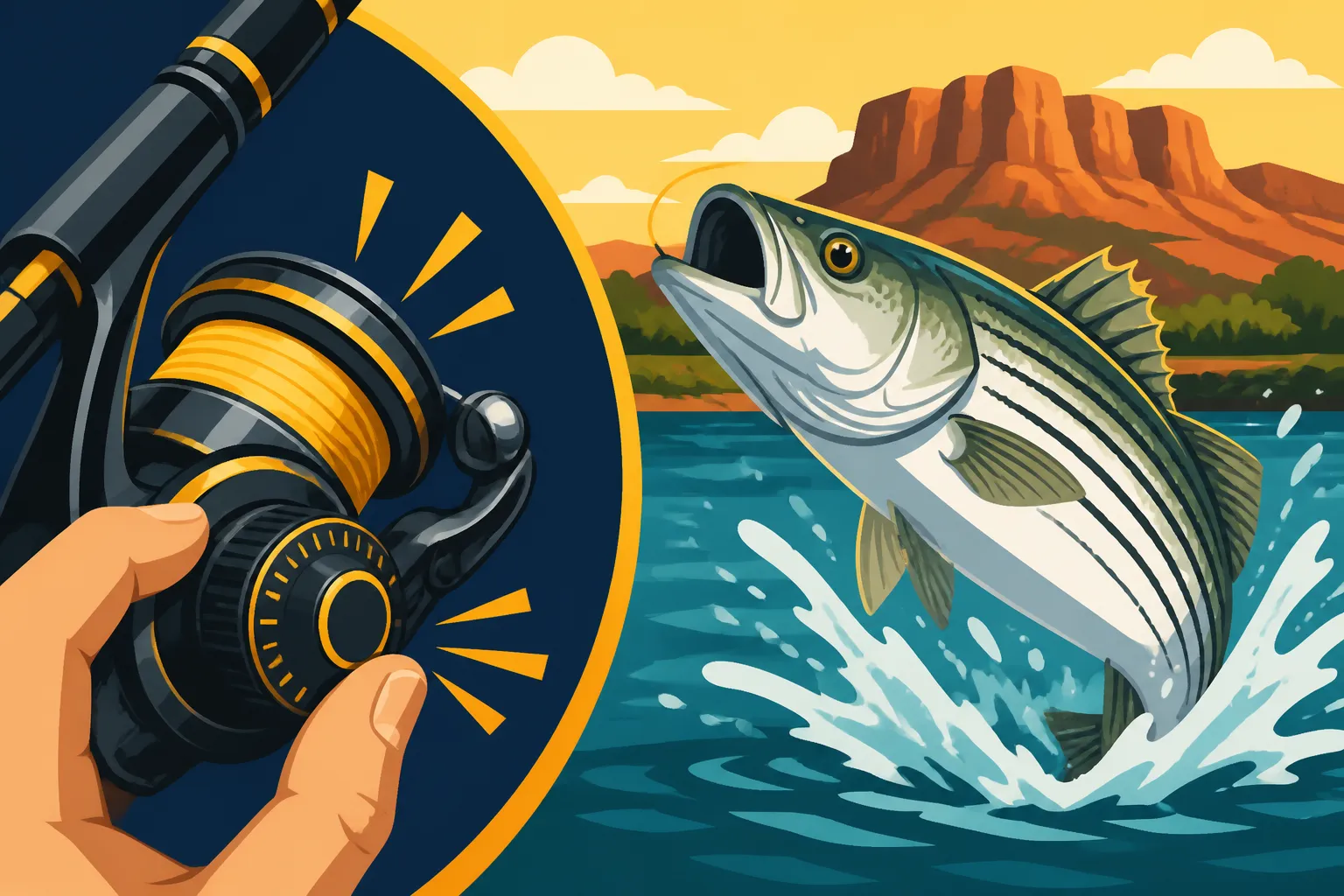
Best Reel Drag Setting for Striped Bass Fishing
There's nothing quite like the electrifying fight of a New Mexico striped bass, especially one of those hefty ones from Elephant Butte. But let's be honest, that heart-stopping moment when a big striper hits, and then you either land it or lose it, often comes down to one critical, often overlooked, factor: your reel's drag setting. Too loose, and you're just reeling in slack; too tight, and snap, there goes your line and your trophy. This guide is all about helping you master that sweet spot, ensuring you're ready for the fight of a lifetime on New Mexico's waters.
Understanding Your Reel's Drag System for Striped Bass
Before we dive into the "how," let's really understand the "what" and "why" behind your reel's drag. It's more than just a knob; it's a vital component that translates directly into whether you conquer that hard-fighting striped bass or end up with a tale of "the one that got away." For anyone targeting these powerful fish, whether it’s in the wide-open expanse of Elephant Butte Lake or other New Mexico waters, a solid grasp of drag mechanics is non-negotiable.
The Mechanics of Drag – How It Works
At its core, your reel's drag system is a sophisticated clutch designed to create friction and allow line to be pulled off the spool under controlled tension. Imagine a big striper making a powerful run – without drag, that fish would either rip the rod from your hands or instantly snap your line. The drag system uses a series of washers (typically carbon fiber, cork, or felt) pressed together by tension from a spring-loaded nut or cam. When a fish pulls harder than your set drag, the washers slip, allowing the spool to rotate and line to peel out. This controlled release of line dissipates the fish's energy, protecting your line and gear from breaking, and ultimately, tiring the fish out so you can bring it in. It's a delicate dance between giving the fish enough line to run, but not so much that it wraps around structure or escapes.
The effectiveness of this system hinges on the quality of those drag washers. High-quality carbon fiber washers, often found in more advanced reels, offer smooth, consistent pressure under heavy loads and don't get sticky or jerky under prolonged heat and pressure, which is exactly what you'll encounter with a powerful striper. Cheaper felt washers can absorb water and degrade, leading to inconsistent drag. This consistency is paramount; a smooth drag prevents sudden jerks in tension that can lead to snapped lines or pulled hooks, especially during those unpredictable head shakes or sudden changes in direction by a big fish.
Furthermore, how tightly those washers are pressed together is what you control with your drag adjustment. Turning the star knob or moving the lever increases the pressure, making it harder for line to come off. Turning it the other way decreases the pressure, allowing line to peel off more easily. The goal is to find that sweet spot where the fish expends energy pulling line against resistance without ever reaching a point where the line can't handle the strain. This is particularly important when Striped Bass Fishing in New Mexico, where these fish are known for their strong, sustained runs.
Types of Drag Systems – Star Drag vs. Lever Drag
When you're out shopping for a new reel, maybe browsing the aisles at Bass Pro Shops or looking through options on Amazon, you'll primarily encounter two main types of drag systems: star drag and lever drag. Both achieve the same goal of applying tension, but they do it in slightly different ways and offer different advantages, especially when battling a tough fish like a striped bass. Understanding the nuances of each can significantly impact your fishing experience and success.
Star drag systems are commonly found on baitcasting and many spinning reels. The drag adjustment knob is typically a star-shaped wheel located next to the reel handle. You turn it clockwise to increase drag tension and counter-clockwise to decrease it. This system is known for its simplicity and robustness. The primary advantage of a star drag is that once it's set, it generally stays put. You can make fine adjustments, but it's not designed for rapid, on-the-fly changes during a fight. For many anglers, particularly those just getting into targeting Striped Bass at Elephant Butte Lake, a star drag is reliable and easy to understand, offering consistent performance as long as the internal components are well-maintained.
Lever drag systems, on the other hand, are often found on high-performance conventional reels, especially those designed for big game or deep-sea fishing, though smaller versions exist for freshwater species like stripers. Instead of a star knob, there's a lever that you slide forward or backward along a marked quadrant. This system offers instant, precise, and repeatable adjustments from "free spool" to "strike" to "full" drag. The "strike" position is usually where you'd set your initial fighting drag, and the "full" position offers maximum resistance. The major benefit here is the ability to quickly increase or decrease drag pressure during a fight without needing to fumble with a rotating knob. This can be a game-changer when a striper makes an unexpected surge towards structure or suddenly changes direction, allowing you to instantly apply more pressure or ease off to prevent a break-off.
Why Drag Is Crucial for New Mexico Stripers
Targeting striped bass in New Mexico's waters, especially big ones, isn't like casually catching panfish. These are powerful, hard-fighting fish that will test your gear and your angling skills to their limits. A properly set drag is not just an advantage; it's an absolute necessity. Without it, you're either going to snap your line in frustration or give the fish too much leeway to throw the hook or wrap around debris.
Stripers are known for their explosive initial runs. They hit hard and bolt, often taking a significant amount of line in a short burst of speed and power. If your drag is too tight during this initial surge, the sudden impact can easily exceed your line's breaking strength, resulting in a snap. Conversely, if it's too loose, the fish will take too much line too quickly, potentially reaching cover or simply escaping before you can gain control. The drag acts as a shock absorber, cushioning these initial powerful surges and allowing the fish to expend energy against constant, smooth resistance. This is where that controlled release of line becomes your best friend.
Beyond the initial strike, a striper's fight can be long and grueling. They'll often make multiple strong runs, punctuated by head shakes and deep dives. Your drag needs to be consistent throughout this entire ordeal. It helps tire the fish efficiently, allowing you to gradually gain line and bring it closer to the boat or shore. Without a reliable drag system, these prolonged battles would inevitably end in either pulled hooks from uneven pressure or snapped lines from unexpected stress points. For serious striper anglers, mastering their drag setting is as important as choosing the right Best Lures for Striped Bass at Elephant Butte or knowing the best fishing spots.
Setting Your Drag for New Mexico Striped Bass Success
Now that we understand the intricate workings of drag, let's get down to the practical application: how to actually set it for those feisty New Mexico striped bass. This isn't a one-size-fits-all situation; your ideal drag setting will be a dynamic number, influenced by your gear, the conditions, and even the size of the fish you're hoping to encounter. But don't worry, there are some excellent starting points and methods to help you dial it in perfectly.
The "25% Rule" and Why It's a Starting Point
One of the most widely accepted guidelines for setting your drag, particularly for heavier species like striped bass, is the "25% Rule." This rule suggests that your drag should be set to approximately 25% of your fishing line's breaking strength. So, if you're using 20-pound test monofilament or braid, your initial drag setting should be around 5 pounds of pressure. This provides a good balance: enough tension to set the hook and fight the fish effectively, but loose enough to prevent your line from snapping under extreme pressure from a powerful run.
To measure this accurately, you'll need a small handheld scale. Thread your line through the guides of your rod, attach it to the hook of the scale, and have someone hold the rod tip high, as if fighting a fish. Pull the scale slowly and steadily away from the reel, noting the reading on the scale as line begins to peel off the spool. Adjust your drag knob or lever until the line starts to slip at roughly 25% of your line's stated strength. This is your theoretical "strike" setting if you're using a lever drag, or your initial setting for a star drag.
It's crucial to remember that this 25% rule is a starting point, not a rigid law. It's a fantastic baseline to ensure you're not going into battle completely unprepared. From here, you'll fine-tune it based on real-world conditions. Factors like the age and condition of your line, the stiffness of your rod, and even the type of knot you're using can influence the true breaking strength and how much stress your setup can handle. For instance, if your line is older or has nicks, you might want to back off the drag a little bit.
Field Testing Your Drag – On the Water Adjustments
The "25% Rule" is great for getting you in the ballpark, but the true test of your drag comes on the water. No scale can perfectly replicate the erratic, powerful surges of a live striped bass. Therefore, field testing and making those crucial on-the-water adjustments are paramount to your success. This is where experience and a keen feel for your tackle really come into play.
Before you even make your first cast, especially if you've changed lines or reels, give your drag a quick check. Pull line directly from the spool by hand, feeling for smoothness and consistent tension. It should pull out evenly without any jerking or sticking. If it feels sticky, loosen it all the way, pull out some line, and then retighten it, sometimes that can reseat the drag washers. Then, set a comfortable starting point that feels right, perhaps a little lighter than your calculated 25% to begin. You can always tighten it slightly.
Once you hook into a fish, especially your first striper of the day, pay close attention to how your drag performs. Is the fish pulling line too easily? Are you not gaining any ground? Tighten it up a click or two. Is the fish making powerful runs, and you're worried about breaking off? Is your rod bent into a precarious arc? Loosen it a touch. It’s a dynamic process during the fight, particularly with a hard-running fish like a striped bass. The key is to make small, incremental adjustments. You don't want to crank it down or open it all the way in one go; that sudden change in tension is often what causes break-offs. This ability to adjust dynamically is a skill that improves with practice, helping you keep control during every stage of the fight.
Factors Influencing Your Ideal Drag Setting
While the 25% rule gives you a foundation, several factors will influence your perfect drag setting for New Mexico stripers. Ignoring these can lead to lost fish, even with a seemingly "correct" initial setting. Thinking about these elements helps you move beyond a simple number to a more intuitive understanding of your tackle.
First and foremost is your fishing line itself. Different line types have different characteristics. Monofilament has stretch, which can act as a built-in shock absorber, allowing you to run a slightly tighter drag. Braided line, with its near-zero stretch, transmits every head shake and surge directly to your rod and reel, meaning your drag must be incredibly smooth and sometimes set a bit lighter to compensate for the lack of give. Fluorocarbon leaders, while strong and abrasion-resistant, also have less stretch than mono, so consider that in your overall setup. The diameter and condition of your line are also vital; a new, well-maintained Best Line Test for Elephant Butte Striped Bass can handle more pressure than old, abraded line.
Next, consider your rod. The action and power of your rod play a huge role. A fast-action, heavy power rod designed for big fish will absorb a lot of the fish's initial shock, allowing for a slightly tighter drag setting. A lighter action rod, or one with more moderate action, will bend more deeply, distributing the stress more effectively and requiring a slightly looser drag to prevent overloading the rod itself. The rod acts as an extension of your drag system, working in conjunction to cushion the blows. If you're using a lighter rod than ideal, your drag will need to be set lighter to compensate. While this article focuses on drag, getting the right rod and reel pairing is crucial, as discussed in guides like Best Rods and Reels for New Mexico Trout Fishing (the principles apply to all species!).
Finally, the lure or bait you're using, and the size of the hook, can also influence your drag. If you're using a large treble hook on a big swimbait, you might get away with a slightly tighter drag for better hook penetration. However, if you're using a smaller, single hook with delicate live bait, too much drag can tear the hook out of the fish's mouth. Furthermore, the environment you're fishing in matters. Are you fishing in open water, or near heavy structure where a fish can quickly break you off? In snag-prone areas, you might need a slightly tighter drag to try and turn the fish away from cover, but this comes with the increased risk of breaking your line.
Here’s a quick overview of how these factors interact:
| Factor | Effect on Drag Setting (Generally) | Rationale |
|---|---|---|
| Line Type | Mono: Tighter; Braid: Lighter | Mono stretch absorbs shock; Braid has no stretch, so drag must absorb all shock. |
| Line Condition | New/Good: Tighter; Old/Damaged: Lighter | New line holds strength; damaged line is prone to breaking. |
| Rod Power | Heavy: Tighter; Light: Lighter | Stiffer rods absorb less shock, relying more on drag; flexible rods absorb more. |
| Rod Action | Fast: Tighter; Moderate: Lighter | Fast action transmits more force; moderate action distributes it better. |
| Hook Size | Large: Tighter; Small/Delicate: Lighter | Larger hooks require more force to set; smaller hooks can pull out or tear. |
| Fishing Area | Open Water: More leeway; Structure: Tighter (risky) | Near structure, you might need to turn the fish, but risk breaking off. |
Common Drag Mistakes and How to Avoid Them
Even seasoned anglers can sometimes make mistakes with their drag, especially when the adrenaline of a big striped bass is pumping. Recognizing these common pitfalls and knowing how to correct them is just as important as knowing how to set your initial drag. Avoiding these errors can mean the difference between a triumphant catch and a frustrating moment of regret.
Too Loose? The Heartbreak of Slack Line
There's nothing quite like the feeling of a powerful strike, only to realize your drag is set far too loose. The result? A whole lot of line peeling off the spool with minimal resistance, and usually, a lost fish. When your drag is too loose, several problems arise, making it incredibly difficult to effectively fight a striped bass.
First, and perhaps most frustratingly, you can't get a proper hook set. Striped bass often have tough, bony mouths, and it takes firm, consistent pressure to drive the hook point home. If your drag slips too easily, the force of your hookset is dissipated, and the hook never fully penetrates, leading to a shallow hook-up that's easily thrown during the fight. Imagine pulling back to set the hook, only to feel the line just slip away rather than engage the fish. That's a classic sign of overly loose drag.
Second, a too-loose drag gives the fish too much control. A big striper can easily make a long, sustained run, taking out yards and yards of line with little effort. This puts the fish in charge, allowing it to reach submerged timber, rock piles, or other abrasive structure where your line is almost guaranteed to fray and snap. You're effectively giving the fish free rein to swim wherever it pleases, and in many New Mexico lakes and rivers, there's plenty of cover for them to use to their advantage. You need to apply enough pressure to turn the fish, steer it away from danger, and ultimately, tire it out. If your drag is too loose, you'll feel like you're simply reeling in slack, making no progress against the fish's power.
Too Tight? The Snap Heard 'Round the Lake
While a loose drag is frustrating, a drag that's too tight is often catastrophic. This is where the sudden snap happens – the sound of your line breaking under strain, or worse, your rod breaking under extreme load. Over-tightening your drag is a common mistake, especially when battling a strong fish like a striper that makes powerful, unexpected surges.
The primary danger of a too-tight drag is exceeding the breaking strength of your line. When a big striped bass makes an explosive run, the sudden force can instantly snap your line if there's no give from the drag system. The drag is meant to allow line to peel off, reducing the shock. If it's too tight, it becomes a fixed resistance, and all that force is transferred directly to your line, knot, or even the rod tip, often with immediate and devastating consequences. This is particularly true if you're using braided line, which has very little stretch to absorb shock.
Furthermore, an overly tight drag can lead to pulled hooks or even bent hooks, especially with smaller or lighter gauge hooks. The immense, unyielding pressure can tear the hook right out of the fish's mouth, or if the hook is not strong enough, it can straighten out completely. It also puts undue stress on your rod and reel, potentially causing permanent damage. Repeatedly fishing with an overtight drag can prematurely wear out your reel's components or even lead to a broken rod blank. The goal is to always stay within the limits of your weakest link in the system, which is usually your line or leader. Understanding the Best Fishing Gear for New Mexico Anglers overall can help you build a balanced system.
Adjusting Mid-Fight – When and How
One of the hallmarks of an experienced angler is the ability to adjust their drag settings during the heat of the battle. This isn't about setting it once and forgetting it; it's about being responsive to the fish's behavior and the dynamics of the fight. Knowing when to adjust and how to do it safely can significantly increase your landing ratio for striped bass.
You should consider adjusting your drag during a fight if you observe a few key indicators. If the fish is making an incredibly powerful, sustained run and you're losing line rapidly, especially if your rod is bent to its maximum and you feel you're about to break off, you need to loosen the drag slightly. Conversely, if the fish has slowed down, is making shorter, weaker runs, and you're struggling to gain line, it might be time to tighten the drag incrementally to apply more pressure and turn its head. Another crucial time is when the fish is nearing your boat or the bank. At this point, many anglers will loosen their drag a tad to allow for any last-minute surges or head shakes that could pop the hook or snap the line when the fish is close. This is also when having a good landing net, as discussed in Best Landing Nets for New Mexico Catch and Release Fishing, becomes critical.
When adjusting mid-fight, always do so in small, controlled increments. If you have a star drag, turn the knob just a quarter or half-turn at a time. If it's a lever drag, slide it just a notch or two. Never crank it all the way down or open it all the way up in one swift motion. Sudden changes in tension are a recipe for disaster. The ideal is to maintain constant tension on the fish, avoiding any slack line, while simultaneously allowing the drag to do its job. Practice this on smaller fish first to get a feel for your reel and line before you hook into that monster striper that demands your full attention and skill. For those fishing from shore, remember that fighting a fish from a fixed position requires extra finesse in drag management compared to a boat that can maneuver, a topic explored in How to Catch Striped Bass From Shore.
Gear Considerations for Optimal Drag Performance
Your reel's drag system doesn't operate in a vacuum; it's part of a larger, interconnected system of gear. To truly get the best performance out of your drag when chasing New Mexico striped bass, you need to ensure all components of your tackle are working harmoniously. This means careful consideration of your rod, line, and even how you maintain your equipment.
Matching Rod and Reel for Striped Bass
One of the biggest mistakes anglers make, which directly impacts drag performance, is mismatching their rod and reel. You wouldn't put a tiny ultralight reel on a heavy surf rod, nor would you put a massive offshore reel on a finesse bass rod. Each piece of equipment is designed to work within a certain range, and for striped bass, that range needs to handle powerful forces.
For New Mexico stripers, especially those found in places like Elephant Butte, you're generally looking for a medium-heavy to heavy power rod with a fast to moderate-fast action. This type of rod has the backbone to handle big fish but enough flex in the tip to absorb shock and cast heavier lures. Your reel should be sized appropriately to balance the rod and hold enough line for those long striper runs. A 3000-5000 series spinning reel or a 15-30 size baitcasting/conventional reel from reputable brands like Daiwa or Penn (available at Bass Pro Shops or via Amazon) would be common choices, depending on the specific application and target size of fish.
A balanced rod and reel setup ensures that when a fish pulls, the stress is distributed evenly. The rod's bend helps absorb some of the shock, allowing the drag to work more smoothly and consistently. If your reel is too small for your rod, or vice-versa, the drag system might be overworked, leading to jerky performance, overheating, and ultimately, failure. The synergy between rod and reel allows your drag to function at its peak, providing the controlled resistance needed to land powerful fish like stripers.
The Importance of Fresh Line and Proper Knots
Even the best drag setting on the most expensive reel can be completely undermined by old, weak line or poorly tied knots. These are often the weakest links in your entire fishing system, and they directly impact how much pressure your drag can safely apply. It's a fundamental aspect of angling that sometimes gets overlooked in the excitement of new lures or fancy reels.
Fishing line, especially monofilament and fluorocarbon, degrades over time due to UV exposure, abrasion, and repeated use. Old line loses its breaking strength, stretch, and abrasion resistance, making it highly susceptible to snapping even under a perfectly set drag. Imagine setting your drag to 25% of your new 20-pound line, only to be fishing with line that's actually degraded to a 12-pound breaking strength – you're effectively fishing with an overtight drag, leading to easy break-offs. It's good practice to spool up with fresh line at least once a season, especially if you're regularly targeting hard-fighting fish. Braided line is more durable but still benefits from being flipped or replaced after significant use, as the section closest to your lure takes the most abuse.
Knots are another critical point. A poorly tied knot can reduce your line's breaking strength by 50% or more. If you're using 20-pound test and your knot only holds 10 pounds, then your actual breaking point is at the knot, regardless of how perfectly your drag is set. Learning a few strong, reliable knots like the Palomar knot for tying lures, or a good fluorocarbon-to-braid knot like the FG knot, is essential. Practice tying them until they are second nature. These strong knots ensure that your line strength is maximized, allowing you to trust your drag setting to absorb the forces of a fighting striper rather than having a weak knot fail prematurely.
Maintaining Your Drag System
Finally, just like any other mechanical part of your fishing gear, your reel's drag system requires proper maintenance to perform optimally. A neglected drag can quickly become sticky, inconsistent, or simply fail when you need it most, turning a potential trophy into a heartbreak story. This is an easy aspect to overlook but one that pays dividends in reliability.
After every outing, especially if you've been fishing in dusty conditions or caught some larger fish, it's a good idea to wipe down your reel. If you've been in saltwater (though New Mexico is freshwater, some might use these reels elsewhere), a quick rinse with fresh water is even more critical. Pay particular attention to the drag knob area. Over time, dirt, sand, salt (if applicable), and old grease can build up around the drag washers, causing them to stick or provide inconsistent tension. This "jerky" drag is a common culprit for snapped lines, as it creates sudden spikes in tension rather than a smooth release.
Periodically, and according to your reel manufacturer's recommendations, you should perform a more thorough cleaning and lubrication of your drag washers. This usually involves carefully disassembling the drag stack, cleaning the washers with a lint-free cloth, and reapplying a light, specialized drag grease (often made of carbon or teflon compounds) if recommended for your specific reel model and washer type. Some modern carbon drag washers are designed to be run dry. Always refer to your reel's manual or a reliable source for specific instructions. By keeping your drag system clean and properly lubricated, you ensure those washers slip smoothly and consistently under pressure, providing you with the reliable performance needed to dominate any New Mexico striped bass that dares to challenge your line.
Disclaimer
This article is for general informational purposes only and does not constitute professional advice. Laws, prices and regulations vary by location and change over time. Consult a qualified professional for guidance on your specific situation.