Best Wading Staff for the San Juan River Current
Navigating the San Juan River can be an angler's dream, but let's be honest, it can also be a bit of a dance with destiny, especially when you're trying to wade through those famously swift currents and over those slick, often unseen rocks. Many of us have felt that heart-stopping moment when a foot slips, and suddenly you're doing a clumsy pirouette with a fishing rod in hand. This guide is all about helping you avoid those unplanned swims by choosing the absolute best wading staff for stability and safety on the San Juan.
Why a Wading Staff is Non-Negotiable on the San Juan River
Let me tell you, if there's one piece of gear I recommend above almost all others for anyone planning to wade the San Juan River, it's a solid wading staff. It’s not just for beginners; even seasoned anglers know that the river can be unpredictable, and a good staff is your best friend when things get tricky.
Understanding the San Juan's Unique Challenges
The San Juan River, particularly the revered Quality Waters section below Navajo Dam, is legendary for its prolific trout and consistent flows. But what makes it great for fish also makes it challenging for wading. The riverbed is often a mix of smooth, moss-covered rocks and irregular gravel, creating a treacherous footing. Add to that the powerful, consistent current that can literally sweep your legs out from under you, and you've got a recipe for potential trouble. The water is often cold, even in summer, so an unexpected fall isn't just a minor inconvenience; it can be genuinely dangerous, leading to hypothermia or injury. I’ve seen strong anglers take tumbles that could have been avoided with a simple staff. Rules for the San Juan River Special Trout Water are specific, and being able to maintain your footing allows you to adhere to them safely.
Furthermore, visibility into the water can be deceptive. What looks like a shallow, easy crossing can quickly deepen, or hide a significant drop-off or a boulder waiting to trip you up. The current itself, while steady, can vary in speed and direction as it flows around submerged features, creating eddies and powerful seams that can catch you off guard. Having that third point of contact with a wading staff gives you an immediate sense of the bottom's contours and the current's true force, letting you make informed decisions before committing your weight.
Beyond Just Balance: The Practical Benefits
While maintaining your balance is undoubtedly the primary role of a wading staff, its utility extends far beyond just keeping you upright. Think of it as an extension of your senses and your body, offering a multitude of practical benefits that enhance your overall fishing experience on the San Juan.
For instance, the staff becomes your eyes and ears on the riverbed. You can probe ahead, feeling for slippery spots, unseen drop-offs, or submerged logs that could snag your foot. This allows you to plan your steps deliberately, rather than reacting to surprises. It's like having sonar for your feet! When the current is particularly strong, you can lean into the staff, using it as a brace to help you push through the water with less effort, saving your energy for casting. New Mexico Fishing Regulations Overview apply to specific areas, and navigating these safely is paramount.
Moreover, if you find yourself needing to cross a slightly deeper section, the staff provides critical support, acting as a stable anchor point as you shuffle across. It can also be incredibly useful for pushing through dense bankside vegetation or even helping you climb over small obstacles on the riverbank as you move from one fishing spot to another. And once you’re in position, rooted firmly in the current, the staff can be a subtle support system, helping you maintain a steady stance for precise casting without expending constant energy on balance. It truly frees you up to focus on the fish.
Key Features to Look for in a San Juan Wading Staff
Choosing a wading staff isn't just about grabbing the first stick you see. For the demanding conditions of the San Juan River, you need to be a bit more discerning. Certain features will make a huge difference in safety, convenience, and durability.
Material and Durability
The material of your wading staff directly impacts its weight, strength, and how it handles the elements. On a river like the San Juan, durability is paramount because your life literally depends on it not failing.
- Aluminum: Many wading staffs are made from aluminum. This is a popular choice because it offers a good balance of strength and affordability. Aluminum staffs are generally robust enough to withstand significant pressure from the current and occasional bumps against rocks. They're also relatively lightweight, which is a plus when you're carrying it all day. However, aluminum can be susceptible to bending if subjected to extreme force, and it can eventually corrode if not properly maintained, especially in constantly wet environments. Look for anodized aluminum for better corrosion resistance.
- Carbon Fiber: If you're looking for the ultimate in lightweight performance, carbon fiber is the way to go. These staffs are incredibly light, which significantly reduces fatigue when you're moving around. Despite their light weight, high-quality carbon fiber staffs are remarkably strong and rigid, providing excellent stability. The downside, of course, is that they tend to be more expensive than their aluminum counterparts. Carbon fiber is also generally more resistant to corrosion, making it a great long-term investment for river fishing. When considering a premium staff, checking out options at places like Bass Pro Shops or online retailers like Amazon can give you a good idea of the range available in both materials.
No matter the material, ensure the staff feels solid and has well-constructed joints or locking mechanisms. Cheaply made staffs can buckle or collapse at the worst possible moment.
Collapsibility and Portability
Unless you plan to carry a full-length wooden staff everywhere, collapsibility is a critical feature for any wading staff destined for the San Juan. You'll want something that can be easily stowed when not in use, yet quickly deployed when you need it most.
- Folding Staffs: These are arguably the most popular type for wade fishing. They typically break down into three or four shorter sections, often connected by an internal elastic cord (like tent poles). When you need it, you simply pull the sections apart and let them snap together. They fold down into a compact size, making them easy to clip onto a vest, pack, or belt. The speed of deployment is a huge advantage when you suddenly encounter tricky wading.
- Telescoping Staffs: These staffs slide into themselves, extending or retracting with a twist-lock or lever-lock mechanism. While they might not be quite as compact as some folding designs, they often feel a bit more rigid when fully extended because they have fewer joints. They can also offer a wider range of length adjustments, which can be useful for different wading depths or angler heights.
- Attachment Options: Consider how the staff attaches to your person. Most come with a small clip or a dedicated sheath that can be secured to a D-ring on your vest, a belt loop, or a backpack strap. A reliable attachment ensures your staff is always within reach but doesn't get in your way when you're casting. A good, strong magnet can also be part of a quick-release system for deployment. Best Wading Boots for New Mexico's San Juan River will also need good attachment points for a staff.
Grip, Tip, and Strap Design
These small details make a big difference in how comfortable and effective your wading staff is in real-world conditions.
- Grip: The grip should be ergonomic and comfortable to hold, even with wet hands or gloves. Cork, foam, or rubberized materials are common. Cork provides a natural feel and good insulation, while rubber or foam offers excellent non-slip properties. Test how it feels in your hand – a good grip prevents fatigue and ensures you maintain control, especially when leaning into a strong current.
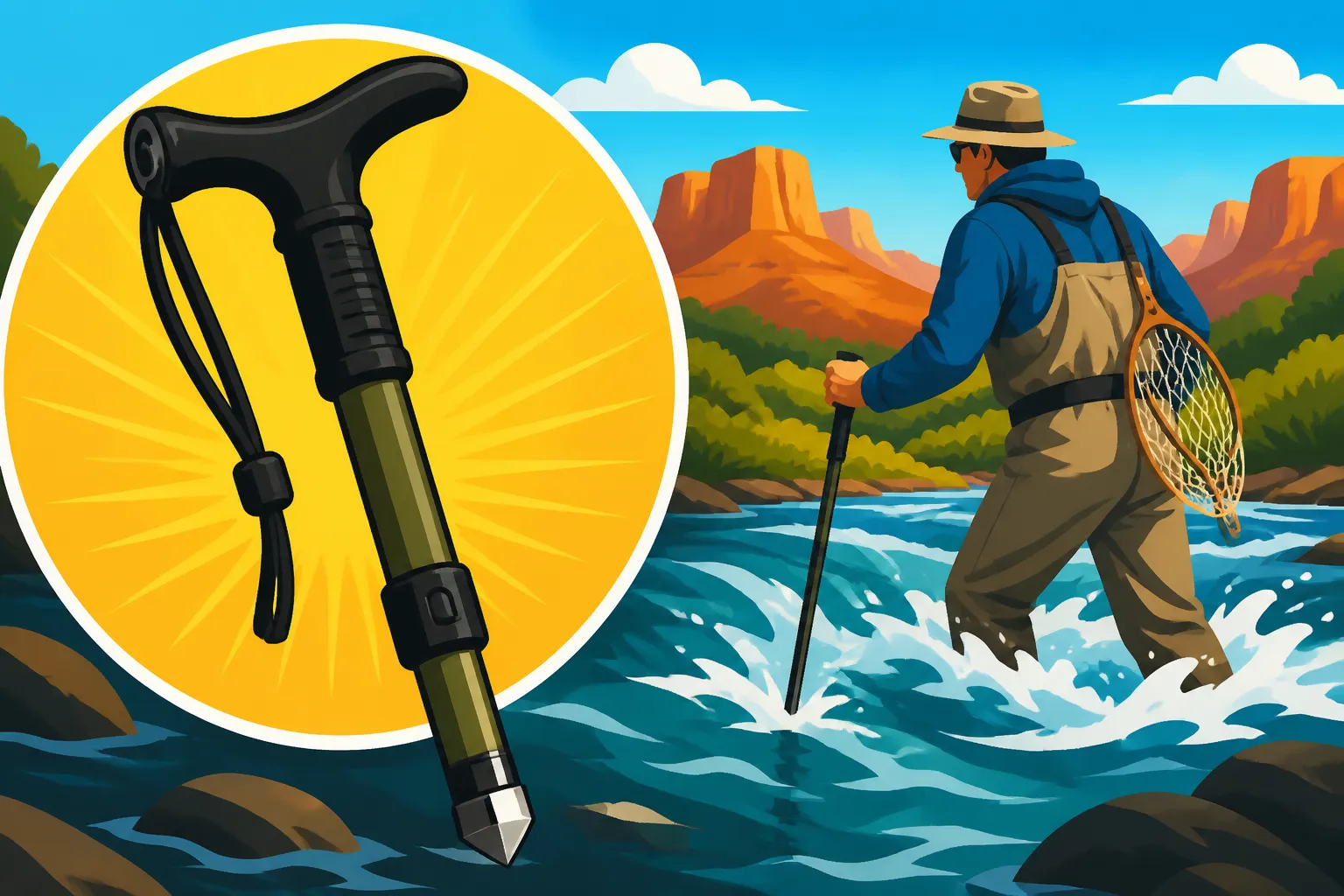
- Tip: This is where the rubber (or carbide) meets the riverbed! The tip is crucial for traction.
- Carbide Tip: This is usually a pointed, hardened metal tip that digs into slippery rocks, gravel, and even mud, providing superior grip. It’s often considered the gold standard for river wading.
- Rubber Tip: A rubber cap can cover the carbide tip, offering a quieter approach and preventing scratches on boat decks or indoor floors. Some staffs come with interchangeable tips, allowing you to switch between carbide for maximum grip on the riverbed and rubber for less aggressive surfaces.
- Large Foot/Basket: Some staffs include a small basket or a wider foot near the tip. This prevents the staff from sinking too deep into soft mud or sand, which can be a lifesaver in silty sections of the river.
- Strap: A wrist strap is essential for preventing accidental loss of your staff if you let go or stumble. Look for an adjustable strap that fits comfortably around your wrist or forearm. Crucially, some high-quality staffs include a "break-away" feature on the strap, designed to detach under extreme tension. This is a vital safety feature that prevents the staff from becoming an anchor, potentially pulling you down if it gets wedged under a rock in a strong current. You don't want to become entangled.
Different Types of Wading Staffs and Who They're For
Just like there are different types of fishing, there are different wading staffs designed for various needs and preferences. Understanding the pros and cons of each will help you choose the best fit for your San Juan adventures.
Foldable Wading Staffs: The Go-To Choice
For the vast majority of anglers heading to the San Juan, a foldable wading staff is simply the most practical and efficient choice. These staffs are designed with portability and quick deployment in mind, making them incredibly versatile for dynamic river environments.
Imagine you're hiking a trail along the San Juan, moving between prime fishing spots. A full-length, rigid staff would be cumbersome, getting tangled in brush or constantly poking you in the back. A foldable staff, however, collapses down into a compact package, often no bigger than a small water bottle. It can be easily tucked into a fishing backpack, clipped to a D-ring on your Best Fishing Backpack and Wading Gear for New Mexico vest, or secured to your wading belt, completely out of the way until you need it.
When you do encounter a section of swift current, a slippery rock garden, or a deeper channel you need to cross, these staffs deploy in seconds. A quick flick of the wrist, and the internal shock cord snaps the sections together, locking into a sturdy, full-length staff. This rapid readiness means you don't waste precious fishing time fumbling with gear, and you can transition seamlessly from hiking to safe wading. They are the ideal balance of convenience, stability, and safety for the typical San Juan angler who values mobility and efficiency. You can find excellent foldable options at outdoor retailers or through online vendors like Amazon, offering a range of prices and materials.
Telescoping and Fixed Staffs: Niche Uses
While foldable staffs dominate the market for their convenience, telescoping and fixed staffs do have their specific applications, especially for those with particular needs or fishing styles.
- Telescoping Staffs: These staffs offer the advantage of adjustable length, which can be great if you anticipate varying wading depths or if multiple people of different heights will be using the same staff. They extend and retract with twist-lock or lever-lock mechanisms. While generally less compact than folding staffs when collapsed, they often feel a bit more rigid because they have fewer connection points, which some anglers prefer for a more 'solid' feel. They're a good choice for someone who might not be hiking long distances but values precise length adjustment and a robust, less segmented feel. However, the locking mechanisms need to be kept clean and functional, as grit can cause them to seize up.
- Fixed Staffs: These are essentially sturdy walking sticks, always at full length. They offer the absolute maximum in stability and rigidity because there are no joints or moving parts to potentially fail. However, their lack of collapsibility makes them incredibly impractical for most wade fishing scenarios on the San Juan. They're difficult to transport in a vehicle, impossible to stow on your person while fishing, and a nightmare to hike with. Their use is generally limited to very short, easy-access wading areas where you can literally walk from your car into the water without needing to carry the staff. Some professional guides might use fixed staffs in specific, well-known sections, or they might be useful for bank anglers who occasionally step into the shallows and want maximum support without concern for portability. For the dynamic and often mobile fishing on the San Juan, they are almost universally a poor choice.
Integrated Staffs: For the All-in-One Angler
Integrated wading staffs are an interesting concept for anglers who love the idea of minimalism and having everything at their fingertips. These are staffs that are built directly into another piece of gear, most commonly a fishing vest or a specialized fishing backpack.
The main draw of an integrated staff is incredible convenience. There's no separate item to remember or clip on; it's always there, usually stored in a dedicated sleeve or compartment within your vest or pack. Deployment is often very quick, pulling out like a sword from a scabbard, and then it's ready for use. This can be fantastic for those who want an ultra-streamlined setup, where every piece of gear has its place and is easily accessible. Best Fishing Gear for New Mexico Anglers often includes such thoughtful designs.
However, the "all-in-one" convenience can sometimes come with compromises. The staff component might not always be as robust or feature-rich as a dedicated, standalone wading staff. For example, the material might be a bit lighter, the grip less ergonomic, or the tip less aggressive than you'd find on a premium standalone staff. The length might also be fixed or have limited adjustment, meaning it might not be perfectly suited to all situations or all anglers. If you rarely use a staff but want one just in case, an integrated option might be perfect. But if you're a serious wader on the San Juan who relies heavily on your staff for stability and safety, you might find that a dedicated, high-quality foldable staff offers superior performance and features for your specific needs. It’s a trade-off between ultimate convenience and specialized function.
Tips for Using Your Wading Staff Effectively on the San Juan
Having the best wading staff in the world won't do you much good if you don't know how to use it properly. There are specific techniques and habits that will maximize your safety and stability on the San Juan River.
Proper Technique for Stability and Safety
Think of your wading staff as an extra leg or a third point of contact. This fundamental principle is key to safe wading.
- The Three Points of Contact: Always strive to have at least three points of contact with the riverbed at all times. This means either two feet and the staff, or one foot and two staff points if you are crossing particularly difficult terrain (using the staff as a pivot point). Before you move a foot, plant your staff firmly. Before you move the staff, ensure both feet are stable.
- Probe Downstream: When moving through the current, always plant your staff downstream of your body first. This creates a stable anchor against the force of the water. If you plant it upstream, the current can push the staff into you, potentially throwing you off balance. Probe the riverbed with the staff, feeling for rocks, holes, or slippery patches, before you commit your foot.
- Lean into the Staff: When crossing or standing in strong current, lean slightly into your staff. This counters the force of the water against your body, effectively turning the staff into a steadying brace. Your weight should be distributed so that the staff takes some of the strain, reducing the effort your legs need to expend on balance.
- Shuffle, Don't Stride: Big steps in moving water are a recipe for disaster. Instead, shuffle your feet, keeping them low to the bottom. Each step should be deliberate and tested with the staff. Lift your feet as little as possible to avoid losing contact with the riverbed and letting the current catch your waders.
- Utilize the Lanyard: Always keep the staff's lanyard around your wrist. If you stumble and momentarily lose your grip, the staff won't float away. Many anglers tuck the staff under their arm or in a vest loop when casting, but keep that lanyard on!
Maintenance and Care for Longevity
A wading staff is a tool, and like any tool, it needs proper care to perform reliably when you need it most. Neglect can lead to rust, sticking joints, or premature wear, which are the last things you want to deal with riverside.
- Rinse After Every Use: After each trip to the river, thoroughly rinse your wading staff with fresh, clean water. This is crucial for removing grit, mud, and any mineral deposits that can accumulate from river water. Fine sand and silt are notorious for gumming up folding joints or telescoping mechanisms.
- Dry Completely: After rinsing, extend or unfold your staff completely and allow it to air dry thoroughly. Pay special attention to the joints and internal components. Storing a staff wet, especially folding designs with shock cords, can lead to mildew, corrosion, and weakening of the elastic over time. Hang it in a well-ventilated area, perhaps with the sections slightly separated to allow air circulation.
- Check Tips and Connections: Regularly inspect the carbide tip for wear or damage. If it's becoming dull, some brands offer replacement tips. For folding staffs, check the shock cord's tension; if it feels loose, it might be time for a replacement. For telescoping staffs, ensure the locking mechanisms are functioning smoothly and aren't corroded or stiff. A little silicone lubricant can sometimes help with sticky joints, but avoid petroleum-based products which can attract dirt.
- Store Properly: When not in use, store your staff in a dry, cool place, preferably out of direct sunlight. If it comes with a protective sheath, use it to prevent damage during storage or transport. Proper maintenance ensures that your wading staff will be ready to provide reliable support and safety for countless trips to the San Juan.
Here’s a quick comparison of common wading staff types:
| Feature | Foldable Wading Staffs | Telescoping Wading Staffs | Fixed Wading Staffs |
|---|---|---|---|
| Portability | Excellent (very compact) | Good (adjustable length) | Poor (always full length) |
| Deployment | Very fast (shock cord) | Moderate (twist/lever lock) | N/A (always ready) |
| Adjustability | Generally fixed length | Excellent (variable length) | Fixed length |
| Rigidity | Good (can have slight play) | Very good | Excellent (most rigid) |
| Best Use Case | Mobile anglers, varied terrain, all-around San Juan use | Anglers needing length flexibility, less hiking | Static bank fishing, short wades from car |
| Common Material | Aluminum, Carbon Fiber | Aluminum | Wood, Aluminum |
| Storage | Clips to pack/vest | Stores smaller than fixed | Must be carried separately |
Disclaimer
This article is for general informational purposes only and does not constitute professional advice. Laws, prices and regulations vary by location and change over time. Consult a qualified professional for guidance on your specific situation.