Choosing a Fish Finder for Deep Reservoirs
There’s nothing quite like the vast, often mysterious waters of New Mexico’s deep reservoirs, is there? You gaze out across Elephant Butte or Navajo Lake, and it just feels immense. But that immensity can quickly turn to frustration when you're trying to find fish in hundreds of feet of water, often with complex underwater structures you can't see. This guide is all about cutting through that mystery and helping you pick the perfect fish finder to transform your deep reservoir fishing experience.
Understanding Your Deep Reservoir Environment
Fishing deep reservoirs in New Mexico is a unique challenge that sets it apart from river fishing or smaller, shallower lakes. The sheer scale and depth of these waters demand a different approach, and that's where a quality fish finder truly earns its keep.
The Challenges of Deep Water Fishing
Think about standing on the shore or sitting in your boat on a place like Conchas Lake. You know there are fish down there, but where? In deep reservoirs, fish aren't just hugging the banks. They could be suspended over open water, hiding in submerged canyons, or clinging to old creek beds hundreds of feet below the surface. The water column itself can be a complex environment, with thermoclines – layers of water with different temperatures – forming at various depths. These thermoclines often act like invisible ceilings or floors, concentrating baitfish and the predators that feed on them. Without a fish finder, you're essentially blind to these critical elements, relying purely on guesswork and luck. It's like trying to find a needle in a haystack, except the haystack is miles wide and hundreds of feet deep.
Key Fish Species and Their Habits
Different fish species behave distinctly in deep water, and understanding their preferences is crucial for effective targeting. For instance, species like walleye at Ute Lake or Conchas Lake are often found near the bottom, especially around structure like old roadbeds, submerged timber, or rocky points. They might suspend just off the bottom in cooler water. Striped bass at Elephant Butte Lake, on the other hand, are notorious for suspending in massive schools in the open water, often chasing baitfish. Elephant Butte Lake Striped Bass Fishing is a whole different ballgame where a good fish finder is practically mandatory. Then you have kokanee salmon at Navajo Lake or Heron Lake, which are often found in specific depth ranges, schooling up and moving with the light or temperature. Navajo Lake Kokanee Salmon Fishing is another pursuit where knowing precisely where those schools are makes all the difference. A fish finder helps you not only locate these fish but also understand their depth and how they relate to the underwater terrain, making your approach much more strategic.
Essential Fish Finder Technologies for Deep Reservoirs
The technology packed into modern fish finders is truly amazing, but not all features are equally vital for deep water fishing in New Mexico. Knowing which ones to prioritize will ensure you get the most bang for your buck and dramatically improve your success.
Traditional 2D Sonar and CHIRP
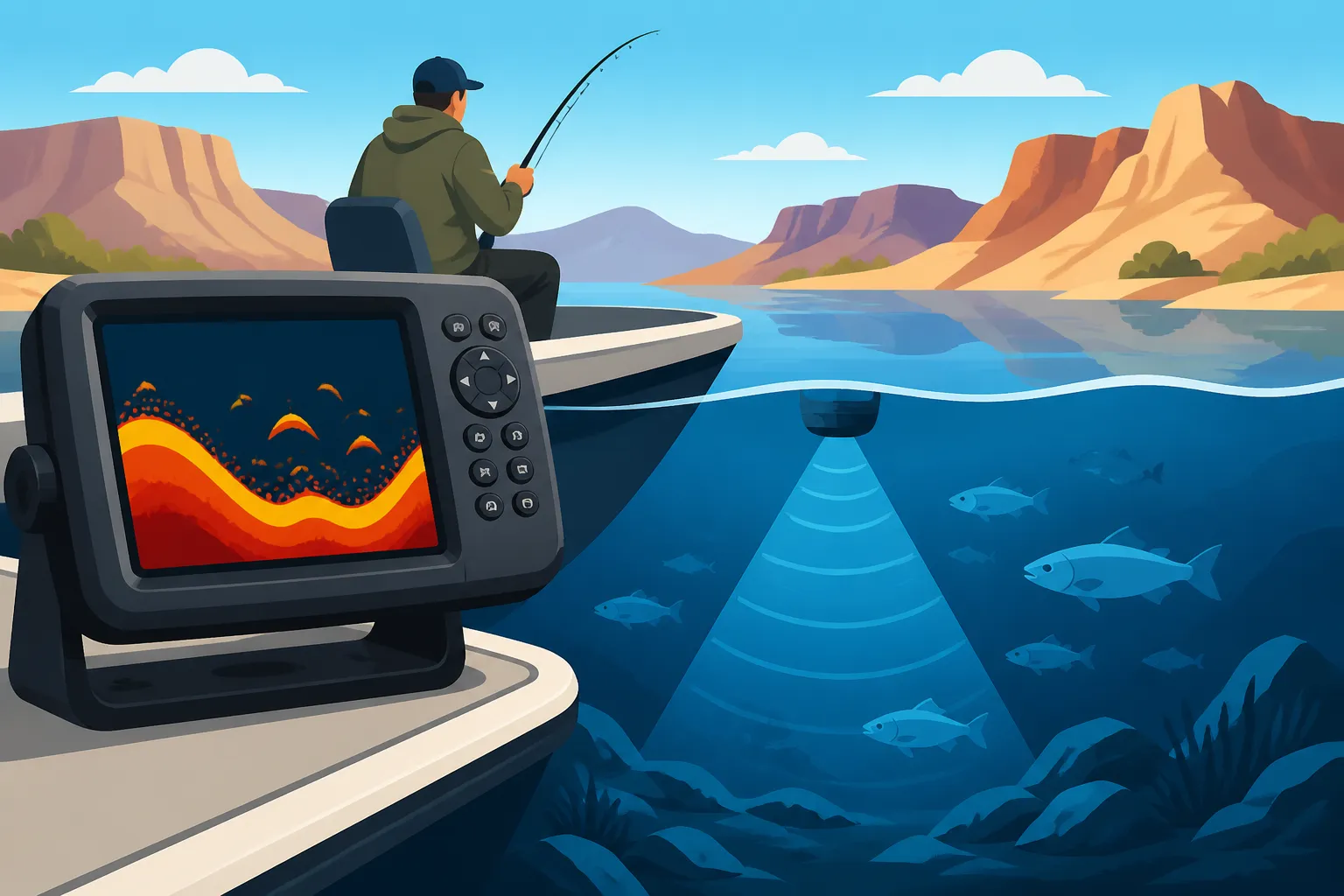
This is the bread and butter of any fish finder, giving you that classic view of the water column. Traditional 2D sonar sends a single frequency sound wave into the water. When it hits something, it bounces back, creating an image on your screen. For deep reservoirs, the challenge is getting a clear return from far below, distinguishing between fish, bait balls, and structure.
Enter CHIRP sonar – it's a game changer, especially for depth. Instead of a single frequency, CHIRP (Compressed High-Intensity Radiated Pulse) sends a continuous sweep of frequencies, from low to high, into the water. This gives it several huge advantages:
- Improved Target Separation: With CHIRP, you can better distinguish individual fish, even when they're tightly grouped or close to the bottom. Instead of a blurry blob, you might see distinct arches. This is invaluable when you're looking for that lone trophy walleye amidst a school of smaller fish.
- Superior Depth Penetration: The multi-frequency sweep allows CHIRP to paint a clearer picture at much greater depths than traditional fixed-frequency sonar. This is absolutely critical for the hundreds-of-feet depths you'll encounter in places like Elephant Butte or Navajo Lake. You'll get less noise and a sharper image of the bottom and fish throughout the water column.
- Enhanced Clarity: The detail and clarity provided by CHIRP means less guesswork. You can more confidently identify baitfish, discern thermoclines, and see how fish are relating to structure, even when they're holding deep. For serious deep water anglers, a CHIRP-enabled fish finder is practically non-negotiable.
Down Imaging and Side Imaging
While 2D CHIRP sonar is excellent for vertical depth and target separation, Down Imaging and Side Imaging provide a more "photographic" view of what's directly beneath or to the sides of your boat. These are incredibly powerful tools for deep reservoir exploration.
- Down Imaging (or DownVu/DownScan): This technology sends a very thin, high-frequency beam straight down, creating a picture-like image of the bottom and anything directly under your boat. It excels at showing detail of submerged timber, rock piles, brush piles, or old foundations that might be overlooked by traditional 2D sonar. If you're drifting over a deep channel and see a cluster of sticks on your Down Imaging, you know that's prime walleye or bass habitat, and you can mark it as a waypoint. It helps you understand what you're looking at, not just that something is there.
- Side Imaging (or SideVu/SideScan): This is perhaps the most revolutionary technology for covering vast deep reservoirs. Side Imaging beams out to the sides of your boat, scanning hundreds of feet to port and starboard. Imagine slowly cruising across a wide flat or alongside a deep submerged ridge on Elephant Butte. With Side Imaging, you can see not just what's directly below, but also schools of fish, submerged structures, and contour changes off to your sides. This allows you to quickly cover huge areas, identify key features, and pinpoint where fish are holding without having to drive directly over them. It's like having an underwater drone scanning left and right, revealing hidden gems in the deep. For example, you might see a school of stripers fifty feet off your port side that your 2D sonar wouldn't have picked up. This drastically reduces your search time and increases your efficiency.
GPS and Mapping Capabilities
In the expansive waters of New Mexico's larger reservoirs, navigation and location memory are just as critical as finding the fish themselves. This is where integrated GPS and detailed mapping shine.
- Integrated GPS: A fish finder with built-in GPS allows you to see your boat's position on a digital map. This is fundamental for knowing where you are, where you've been, and where you want to go. Beyond basic navigation, GPS lets you mark waypoints for productive spots – that brush pile where you caught a nice bass, the rock reef holding walleye, or the channel bend where you consistently find kokanee. Being able to return precisely to these spots, even weeks or months later, is invaluable.
- Detailed Contour Maps: Many modern fish finders come preloaded with high-definition lake maps (often from providers like Navionics or C-MAP), or allow you to purchase and load them. These maps show detailed bathymetry – the underwater topography – including depth contours, submerged creek beds, old roads, and humps. Imagine looking at a topographical map of a mountain range, but it's all underwater! This allows you to scout potential fishing spots before you even get there, identifying deep drops, saddles, and ledges where fish are likely to congregate. For example, if you're targeting Walleye at Conchas Lake, a detailed contour map will show you the exact breaks and changes in depth where walleye love to ambush prey. These maps, combined with your real-time sonar, give you a complete picture of the underwater world.
- Autocharting/Live Mapping: Some advanced units even offer the ability to create your own custom maps in real-time as you drive. This is phenomenal for less-mapped areas or for detailing specific spots with incredible accuracy. As you motor around, your fish finder will draw new contours on the screen based on the sonar readings, giving you an unparalleled understanding of the bottom.
Key Features to Prioritize for Deep Water Performance
When you're staring at a wall of fish finders at a Bass Pro Shops or scrolling through options on Amazon, it's easy to get overwhelmed. For deep reservoir fishing, certain specifications and features make a much bigger difference than others.
Transducer Power and Cone Angle
The transducer is the heart of your sonar system, sending and receiving the sound waves. For deep water, its power and how it disperses that power are paramount.
- Higher Wattage (Power): This is straightforward: more power equals better depth penetration and a stronger return signal. If you're fishing in hundreds of feet of water, a low-wattage unit simply won't have the "oomph" to send a clear signal all the way down and get a strong echo back. While specific wattage numbers vary between manufacturers and technologies (like CHIRP vs. traditional 2D), generally, the higher the wattage capability, the better. This translates to clearer images at depth, less noise, and a more accurate depiction of fish and structure far below. Don't skimp on this if deep water is your primary hunting ground.
- Cone Angle: The cone angle refers to the width of the sonar beam.
- Wider Cone Angles (Lower Frequencies): These cover a larger area of the bottom, which is great for searching for schools of fish or broader structures. However, in deep water, a very wide cone can spread the signal too thin, losing definition, and it can also "see" objects from a long way off, making precise location difficult.
- Narrower Cone Angles (Higher Frequencies): These provide more detail and better target separation directly beneath the boat. They're excellent for pinpointing specific fish or structures in deep water.
- Multi-Frequency Transducers: The best scenario for deep water is a transducer that offers multiple frequencies (and thus multiple cone angles). This is where CHIRP technology truly shines. It allows you to use lower frequencies (broader cone, better depth) for general searching and higher frequencies (narrower cone, better detail) for dissecting specific areas. The ability to switch or simultaneously display different frequencies gives you incredible versatility for Fishing New Mexico Reservoirs in Summer Heat or deep winter patterns.
Screen Size and Resolution
Imagine trying to read a detailed map on a postage stamp – that's what a small, low-resolution screen can feel like when trying to interpret complex sonar data from deep water.
- Screen Size: A larger screen simply provides more real estate for displaying information. You'll want to run multiple views simultaneously: 2D sonar, Down Imaging, Side Imaging, and your GPS map. Trying to cram all that onto a tiny screen means everything is minuscule and hard to decipher. A larger screen allows you to split your display effectively, making it easier to see a fish arch on your 2D, verify it's a piece of submerged timber on your Down Imaging, and see the surrounding terrain on your map, all at a glance. For serious deep water work, I'd strongly recommend at least a 7-inch display, with 9-inch or larger being even better if your budget allows.
- Resolution: This refers to the number of pixels on the screen (e.g., 800×480, 1024×768, etc.). Higher resolution means a sharper, more detailed image. In deep water, where echoes are fainter and targets can be small, high resolution is critical for distinguishing subtle differences – a bait ball from a thermocline, a small fish from a large one, or the texture of the bottom. A large screen with poor resolution is still difficult to interpret. Aim for the highest resolution you can afford within your chosen screen size.
User Interface and Ease of Use
It sounds obvious, but a fish finder packed with advanced features is useless if you can't figure out how to operate it quickly and intuitively on the water.
- Intuitive Menus: When you're actively fishing, you don't want to be fumbling through a labyrinth of menus to change a setting. Look for units with clear, logical menu structures and easily accessible shortcuts for common functions. Many brands have excellent, user-friendly interfaces, but spend some time with demo units in a store like Bass Pro Shops or watch online reviews to get a feel for the menu layout.
- Physical Buttons vs. Touchscreen: Both have their pros and cons. Physical buttons are often preferred in cold or wet weather, or when wearing gloves. Touchscreens offer tablet-like ease of use and quick navigation. Some units offer a hybrid approach, which can be the best of both worlds. Consider your typical fishing conditions and personal preference.
- Customizable Displays: The ability to customize your screen layouts (what information is displayed and where) is a huge plus. You might want a full-screen 2D sonar for searching, then switch to a split-screen of Down Imaging and mapping when you find a promising spot. Your fish finder should allow you to create and save these custom views for quick access. Ultimately, the best fish finder is the one you will use effectively, not just the one with the most bells and whistles.
Budgeting and Where to Buy Your Fish Finder
Just like buying any piece of specialized gear, fish finders come in a wide range of price points. It's easy to get caught up in the desire for the absolute best, but finding the right balance between features, performance, and cost is key.
Different Price Tiers and What They Offer
Fish finders generally fall into a few categories, and understanding what you get at each level can help manage expectations and your wallet. Remember, I can't give specific prices, but I can describe the shape of the cost.
- Entry-Level (Often Single-Purpose): These units typically focus on basic 2D sonar and perhaps simple GPS capabilities. They might have smaller screens and lower resolution. While they can tell you the depth and show some basic fish arches, they won't offer the detailed imaging (Down/Side Scan) or advanced CHIRP technologies crucial for truly dissecting deep water. They might be fine for smaller ponds or very shallow lakes, but for the vastness of New Mexico's big reservoirs, they’ll leave you wanting more.
- Mid-Range (Good Value for Deep Water): This is often the sweet spot for many serious deep water anglers. Units in this category typically offer full CHIRP 2D sonar, Down Imaging, and integrated GPS with mapping capabilities. You'll see larger screens (7-9 inches) with good resolution. They provide excellent target separation, depth penetration, and the ability to clearly visualize structure. This tier often represents the best balance of performance and features without breaking the bank. You'll be able to confidently locate fish and structure in most deep reservoir scenarios.
- High-End (Full Featured, Networked Systems): These are the flagship models, often with massive screens (10+ inches), ultra-high resolution, all forms of sonar (CHIRP, Down, Side, and often forward-facing sonar), advanced networking capabilities (connecting to trolling motors, radar, multiple displays), and extensive mapping options. They offer unparalleled detail and versatility, often with processing power that makes everything incredibly fast and fluid. While powerful, the cost for these systems can be substantial, making them an investment primarily for professional guides or anglers who demand every possible advantage and spend a significant amount of time on the water.
Shopping for Your Fish Finder
When you're ready to make a purchase, take your time and do your research. Don't rush into it.
- Specialized Retailers: Stores like Bass Pro Shops are fantastic for fish finders. They often have demo units rigged up that you can play with, giving you a hands-on feel for the user interface, screen clarity, and physical size. The staff there can often offer valuable advice based on local fishing conditions and specific brands. You can also often see a wider array of transducers and mounting options.
- Online Platforms: Websites like Amazon offer a massive selection, often with competitive pricing and detailed customer reviews. The sheer volume of information can be overwhelming, but it’s an excellent place to compare models, read specifications, and get insights from other anglers. Just be sure to verify the seller and warranty information.
- Research, Research, Research: Before you commit, read reviews, watch YouTube videos of the units in action (especially on deep water!), and compare specifications side-by-side. Pay attention to feedback regarding ease of use, screen visibility in bright sunlight, and actual performance in challenging conditions. Look up information on specific brands like Garmin, Lowrance, Humminbird, and Raymarine – they all have excellent offerings, but each has its own strengths and nuances.
Integrating Your Fish Finder into Your New Mexico Fishing Setup
Getting the right fish finder is only half the battle. Properly installing it and, crucially, learning how to interpret its display will unlock its full potential on the deep waters of New Mexico.
Mounting Considerations
The transducer, the part that actually sends and receives the sonar waves, needs to be mounted correctly to function optimally, especially in deep water where signal integrity is paramount.
- Transom Mount: This is the most common and easiest option for most boats. The transducer mounts to the back of the boat's transom, just below the waterline. It's relatively simple to install and adjust, and it provides a clear view of the water, especially for 2D and Down Imaging. However, it can be susceptible to turbulence from the boat's motor at high speeds, which can affect signal quality. For Side Imaging, a transom mount needs to be carefully placed to ensure an unobstructed view to both sides.
- Through-Hull Mount: For boats with deeper hulls or those where maximum signal clarity at speed is desired, a through-hull transducer is ideal. It mounts through a hole drilled in the bottom of the boat, placing the transducer directly in undisturbed water. This offers the best performance, but it's a more involved installation, often requiring professional help and creating a permanent hole in your boat. If you spend a lot of time running at speed on a large reservoir like Elephant Butte, this can be a worthwhile investment.
- Trolling Motor Mount: Many anglers who use electric trolling motors choose to mount a dedicated transducer directly to the trolling motor's lower unit. This offers excellent maneuverability and a clear view, especially for exploring shallow areas or specific structures while on the electric motor. However, it typically won't be your primary deep water transducer for high-speed use. Some advanced trolling motors even have transducers built right into them, offering seamless integration. Consider your boat type and how you fish most often when choosing a mounting option. For New Mexico Boat Registration and Titling Guide and related topics, ensure your boat is properly set up before hitting the water.
Learning to Interpret the Screen
This is perhaps the biggest hurdle for new fish finder users. The screen isn't showing you a photograph; it's showing you interpreted sound waves, and learning to "read" that information takes practice.
- Fish Arches vs. Clutter: On 2D sonar, fish often appear as arches. A full arch usually indicates a fish passed through the entire cone of the sonar beam. Half arches or broken lines can mean a fish was on the edge of the beam. However, learning to distinguish actual fish arches from submerged branches, bubbles, or other clutter is key. The more time you spend watching your screen, the better you'll become.
- Bottom Composition: Your fish finder can tell you about the bottom. A hard, rocky bottom will often show a thicker, more intense return line, sometimes with a "second echo" below it. A soft, muddy bottom will typically show a thinner, less intense line. This helps you identify prime habitat for different species.
- Bait Balls and Predators: Look for dense clouds of dots or lines on your 2D sonar – these are often schools of baitfish. When you see larger, more distinct arches or lines appearing around or just below these bait balls, you've likely found active predators. This is a common scenario when Elephant Butte Lake Striped Bass Fishing.
- Structure and Cover: Down Imaging and Side Imaging are phenomenal for identifying structure. You'll see submerged trees, rock piles, ledges, and drop-offs with incredible clarity. Learning to correlate what you see on these views with what your 2D sonar is telling you will give you a comprehensive picture.
- Practice, Practice, Practice: The best way to learn is to simply spend time on the water with your unit. Start by watching how familiar objects (like the anchor you drop, or a known rock pile) appear on the screen. Experiment with settings like sensitivity and range. Over time, you'll develop an intuitive understanding of what your fish finder is showing you, turning guesswork into informed decisions and making your deep reservoir fishing expeditions much more successful. You'll soon be able to use your fish finder to locate schools of Kokanee at Navajo Lake or pinpoint the precise depth where walleye are holding.
| Fish Finder Technology | Best Use Case for Deep Reservoirs | Key Benefit | Considerations |
|---|---|---|---|
| CHIRP 2D Sonar | Finding suspended fish, general depth, bottom structure | Superior target separation, depth penetration, clarity | Essential for most deep water fishing |
| Down Imaging | Detailed view of structure directly below the boat | Photographic-like detail of submerged objects (trees, rocks) | Great for confirming what 2D sonar sees |
| Side Imaging | Scanning wide areas to find structure and schools off to the sides | Covers vast areas quickly, identifies hidden features | Requires careful transducer placement; learning curve |
| GPS & Mapping | Navigation, marking waypoints, understanding underwater topography | Find your way, return to spots, scout potential areas | Detailed maps may be extra; essential for large waters |
Disclaimer
This article is for general informational purposes only and does not constitute professional advice. Laws, prices and regulations vary by location and change over time. Consult a qualified professional for guidance on your specific situation.