Gear That Helps With High Wind Fishing at Elephant Butte
Anyone who has spent a decent amount of time fishing the wide-open waters of Elephant Butte Lake will tell you that the wind can be an absolute game-changer, often turning a beautiful, serene morning into a wild, choppy afternoon. Trying to keep your boat positioned, make an accurate cast, or even just stay comfortable when the gusts are howling can feel like an impossible task, making many anglers pack up early. This guide is designed to equip you with the knowledge about specific gear and smart strategies that can not only help you endure high winds at Elephant Butte but actually thrive in them, ensuring your fishing experience remains enjoyable and productive.
Understanding the Unique Challenges of Elephant Butte's Wind
Before we dive into the gear, it's crucial to acknowledge why wind at Elephant Butte can be such a formidable opponent. It's not just a breeze; it's often a sustained, powerful force that affects everything from boat stability to lure presentation. Many anglers head out expecting calm water, only to be caught off guard when the weather shifts, leading to frustration and often, a premature end to their fishing day.
The Nature of Wind on Large Reservoirs
Elephant Butte is New Mexico's largest body of water, and its sheer size means there's a vast expanse for the wind to gather strength and build up significant chop. Unlike smaller, more sheltered lakes or rivers, there are few natural barriers to break the wind's momentum. You might start your day in a calm cove, but once you venture into the main lake channels or the open expanses, that's when you really feel the wind's power. It can whip up quickly, creating whitecaps that make navigating a challenge, let alone trying to focus on fishing. This isn't just a minor inconvenience; it can truly dictate where and how you can effectively fish, pushing your boat much faster than you’d like or making it impossible to hold a subtle presentation.
Impact on Boat Control and Positioning
The most immediate and obvious impact of high wind is on your boat's control. Imagine trying to hold your boat on a specific submerged point or a rocky ledge when the wind is constantly trying to push you off. Standard boat positioning, which relies on a calm drift or precise trolling, becomes incredibly difficult. Your drift speed might increase dramatically, meaning your lures are moving too fast through the strike zone, or you're simply blown past potential hot spots before you can even get a good read on them. This constant battle with the elements can be mentally and physically exhausting. Without the right gear and techniques, you'll spend more time fighting your boat and less time actually fishing, which defeats the whole purpose of being out there.
Essential Gear for Maintaining Boat Control
When the wind picks up, having the right tools to keep your boat where you want it is paramount. This isn't just about comfort; it's about making sure your lure is in the strike zone long enough to entice a bite. Investing in specialized gear designed for these conditions can dramatically improve your success rate and overall enjoyment.
Robust Anchoring Systems
Traditional anchors often struggle in high winds, especially on large, silty, or rocky bottoms like those found at Elephant Butte. You might be dropping anchor only to find your boat still dragging or swinging wildly. A truly effective anchoring system for windy conditions often involves more than just a heavier anchor.
For boats, a sturdy conventional anchor combined with plenty of chain – often as much chain as the anchor's length, or even more – can help the anchor dig in and hold better. Consider an anchor specifically designed for maximum holding power, like a box anchor or a heavier fluked anchor, rather than a lightweight grapnel often used for smaller craft. The key is to have enough scope (the ratio of anchor line to water depth) to ensure the anchor is pulling horizontally along the bottom, not lifting. For particularly gusty days, some anglers even employ a dual-anchor system, dropping one from the bow and one from the stern to really lock the boat into position. This level of holding power means you can focus on fishing that specific brush pile or deep channel edge without constantly drifting away. You can find a good selection of these heavy-duty anchoring solutions at places like Bass Pro Shops or online retailers. If you're planning on fishing a specific area intensively, understanding Best Kayak Anchor for Windy Reservoirs can provide even more insight into how these systems are engineered to resist strong currents and wind.
High-Performance Trolling Motors
For active fishing, especially when trying to stay on structure or work a shoreline, a powerful trolling motor with advanced GPS capabilities is a game-changer. Standard trolling motors, particularly those with lower thrust, will simply be overwhelmed by strong winds at Elephant Butte, leaving you frustrated as you're pushed off course.
Look for models with high thrust ratings (measured in pounds) and a long shaft to ensure the prop remains submerged even in choppy water. More importantly, consider a motor with GPS-controlled "spot-lock" or "anchor" features. These systems use satellite technology to hold your boat precisely in place, counteracting wind and current with remarkable accuracy. Imagine being able to cast repeatedly to a specific point, hands-free, while the trolling motor automatically adjusts to keep you there. Brands like Minn Kota's Ulterra or Terrova models, or MotorGuide's Xi5, are popular choices that offer these capabilities. While they represent a significant investment, the ability to maintain boat position effortlessly in wind is invaluable. When considering which model to get, it’s worth looking into Best Trolling Motors for New Mexico Lakes to see how different options perform in varying conditions.
Drift Socks and Planning Your Drifts
Sometimes, the goal isn't to stay perfectly still, but to control your drift speed and orientation. This is where drift socks, also known as drift anchors or sea anchors, come into play. They are essentially parachute-like devices that deploy in the water, creating drag and slowing your boat's drift.
When deployed off the bow, a drift sock can slow your forward movement, allowing your lures to stay in the strike zone longer, especially when targeting suspended fish or working large flats. Deploying two drift socks, one off each side, can also help to orient your boat perpendicular to the wind, presenting a smaller profile and creating a more stable platform for casting. This is particularly useful for techniques like walleye trolling or crappie fishing where a controlled, slow drift is key. Without a drift sock, the wind might push your boat so fast that your baits are constantly skipping over potential fish. Learning to strategically deploy and retrieve these tools can turn a chaotic windy drift into a controlled, productive one. These are readily available on Amazon or through any reputable marine supplier. For overall boating considerations at this large body of water, it’s helpful to check out Best Boats for New Mexico Reservoir Fishing.
| Gear Type | Primary Benefit in High Wind | Best Use Case | Example Scenario |
|---|---|---|---|
| Heavy Anchor + Chain | Superior Stationary Holding | Targeting precise structure; overnight holding | Staying on a specific submerged hump for bass |
| GPS Trolling Motor | Precise Position Holding; Hands-Free | Working shorelines; spot-fishing structure | Holding boat on a brush pile for crappie in gusts |
| Drift Sock | Controlled Drift Speed & Orientation | Trolling; covering large areas; slowing down | Slowly drifting a deep flat for walleye |
| Boat Fenders | Protection from Docks/Other Boats | Launching/docking in crosswinds | Preventing scrapes when tying up at Elephant Butte marina |
Optimizing Your Casting and Line Management
High winds don't just push your boat around; they wreak havoc on your casting accuracy and line control. Trying to present a lightweight lure in a stiff crosswind feels like trying to thread a needle in a hurricane. But with the right setup and a few adjustments to your technique, you can overcome these challenges.
Choosing the Right Rod, Reel, and Line Setup
Your fishing tackle plays a huge role in wind performance. For casting into or across the wind, a longer, faster action rod can help you generate more line speed and load more effectively, punching through the gusts. Consider a medium-heavy or heavy power rod, even for smaller species, to give you the backbone needed to fight the wind. A shorter rod, while sometimes easier to manage in tight spaces, will offer less leverage against the wind.
When it comes to your reel, a smooth, high-quality reel with an excellent drag system is always important, but particularly so when fighting fish in windy conditions where surges can be unpredictable. More critically, your line choice can make or break your day. Monofilament line, with its higher diameter and stretch, acts like a sail in the wind, creating large bows that make bite detection and hook sets difficult. Fluorocarbon line, with its lower diameter and density, sinks better and has less stretch, reducing wind interference. Braided line is often the top choice for windy conditions due to its incredibly thin diameter (which catches less wind) and zero stretch, offering superior sensitivity and hook-setting power. However, braid can be more visible, so a fluorocarbon leader is often a good compromise. You can find a wide range of these specialized lines and rods at Bass Pro Shops, or research options like those on Amazon. For understanding the various lines available, take a look at Best Line Weight for New Mexico Fishing.
Weighting Your Lures and Baits
One of the simplest yet most effective ways to combat wind is to add more weight to your presentation. A lightweight lure might be perfect on a calm day, but in 20 mph winds, it'll just get tossed around like confetti. This often means upsizing your jig heads, using heavier sinkers for bottom presentations, or choosing crankbaits that dive deeper and have more mass.
If you're fishing soft plastics, instead of a 1/8 oz jig head, switch to a 1/4 oz or even 3/8 oz. For Carolina rigs, increase your bullet weight. For live bait, use a heavier slip sinker to get your bait down quickly and keep it there. The extra weight helps your lure cut through the wind during the cast, achieve a more consistent trajectory, and then sink faster and stay on the bottom more effectively once in the water. This also helps reduce slack line caused by wind bowing, allowing for better feel and quicker hook sets. Don't be afraid to experiment with heavier options than you might typically use; the goal is control and presentation.
Techniques for Casting in Wind
Beyond the gear, adapting your casting technique is essential. Avoid high, arcing casts that give the wind ample opportunity to grab your line and lure. Instead, focus on low, side-arm casts that keep your lure closer to the water's surface, minimizing its exposure to crosswinds. If you're casting into the wind, use a powerful overhead cast, aiming slightly lower than normal to punch through the resistance.
When casting with the wind at your back, be cautious not to overpower your cast, as this can lead to tangles or overshooting your target. The key is to watch your line and the wind's direction. After your cast, immediately lower your rod tip to the water's surface to reduce the amount of line exposed to the wind. Maintain a tight line as much as possible, reeling in slack promptly to stay in contact with your lure. This active line management is crucial for detecting subtle bites and making effective hook sets. It takes practice, but mastering these techniques will save you a lot of frustration.
Personal Comfort and Safety in Windy Conditions
It’s easy to focus solely on fishing gear, but ignoring your personal comfort and safety when battling high winds can turn an adventure into a miserable experience. Elephant Butte is a big lake, and conditions can change quickly, making preparation key.
Appropriate Apparel and Sun Protection
Wind can dramatically amplify the effects of cold or heat, making proper layering and sun protection critical. Even on a warm day, a persistent wind can lead to dehydration or windburn if you're not adequately covered.
Layering: Wear multiple layers that you can add or remove as conditions change. A good base layer wicks moisture, a mid-layer provides insulation, and an outer layer offers wind and water resistance. A quality windbreaker or rain jacket is invaluable, even if there's no rain in the forecast, simply for cutting through the wind chill. Brands like Columbia or Patagonia offer excellent options for active outdoor wear that are both breathable and protective.
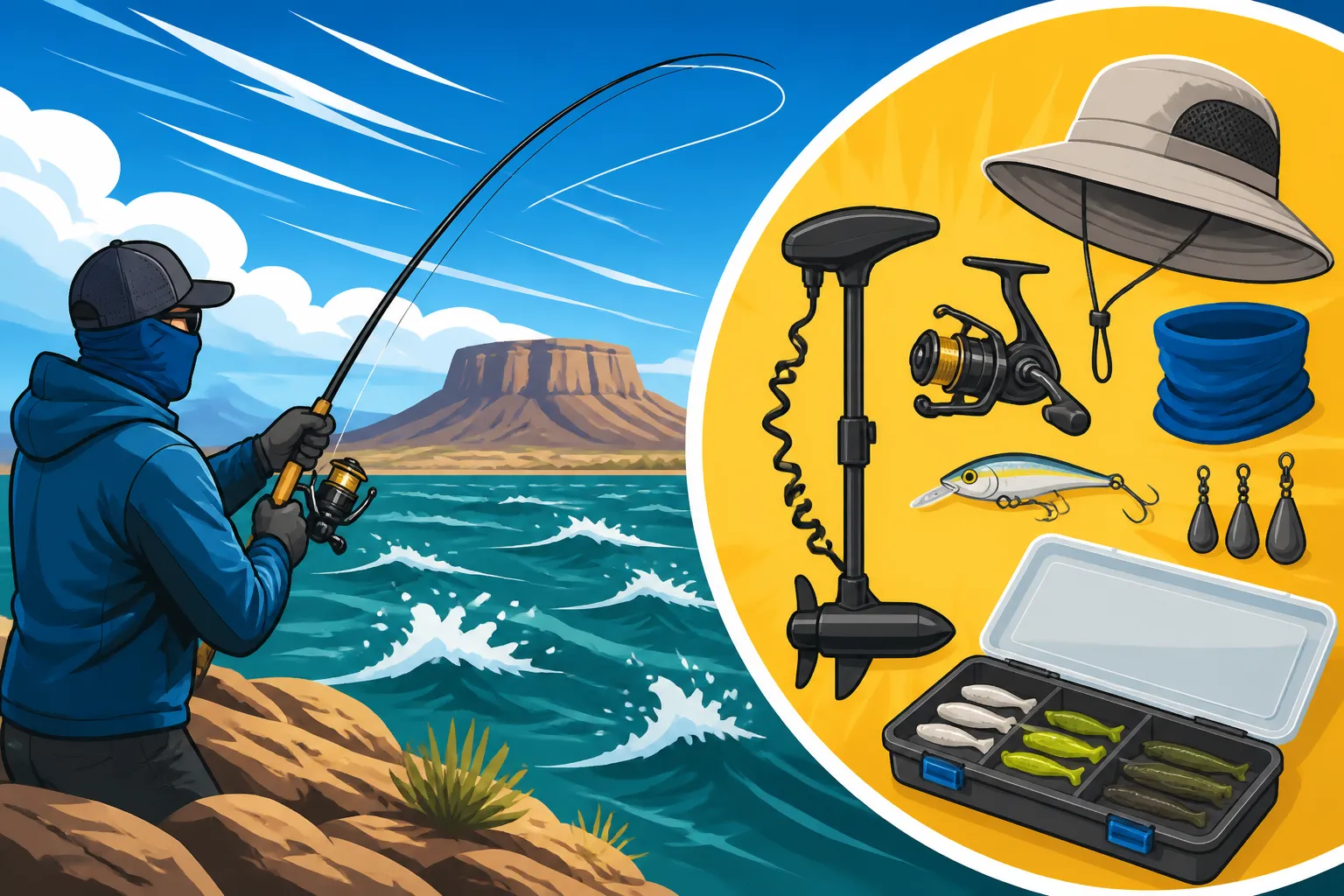
Sun Protection: The New Mexico sun is intense, and the wind can make you forget how quickly you're burning. Always wear a wide-brimmed hat or a baseball cap with a neck gaiter (buff) to protect your face and neck. Polarized sunglasses are non-negotiable for reducing glare and spotting fish, especially in choppy water. And, of course, liberal application of high-SPF sunscreen is a must. Don't forget the back of your hands and ears! For more details on protecting yourself, see Best Sun Protection Gear for New Mexico Reservoir Fishing.
Essential Safety Equipment
Safety is paramount, especially when boating on a large, potentially rough body of water like Elephant Butte. The wind can whip up waves quickly, turning calm stretches into challenging open water.
Life Jackets: Every person on board must have an easily accessible, properly fitting life jacket. In choppy conditions, it's highly advisable to wear your life jacket at all times, not just have it stowed away. Even strong swimmers can be quickly overwhelmed by cold water or unexpected boat movements.
Kill Switch: If your boat has an outboard motor, ensure the kill switch lanyard is always attached to you or the operator. If you're accidentally thrown from the helm, this will immediately cut power to the engine, preventing the boat from circling dangerously or motoring away from you.
Communication: Cell service can be spotty on parts of Elephant Butte. Carry a fully charged cell phone in a waterproof case, but also consider a marine VHF radio for reliable communication with other boats or shore in case of emergency. A whistle or air horn is also crucial for signaling for help. Reviewing Required Safety Gear on a New Mexico Boat can provide a comprehensive checklist to ensure you're fully prepared for any eventuality. Don't let a sudden gust turn your fishing trip into a perilous situation.
Disclaimer
This article is for general informational purposes only and does not constitute professional advice. Laws, prices and regulations vary by location and change over time. Consult a qualified professional for guidance on your specific situation.