Best Fly Line Weight for New Mexico Trout
One of the trickiest decisions for any angler looking to cast a fly in New Mexico, especially when you're just starting out or exploring new waters, is figuring out the best fly line weight. It’s not just a number; it dictates how your rod performs, how delicately your fly lands, and ultimately, how successful you might be in tricking a wily trout. This guide will help demystify fly line weights, giving you the confidence to choose the perfect setup for the diverse trout fishing opportunities New Mexico has to offer.
Understanding Fly Line Weight Basics for Trout Fishing in New Mexico
When you first dive into fly fishing, all the numbers and acronyms can feel like learning a new language. But understanding fly line weight is foundational to enjoying your time on the water, especially when you're targeting trout in New Mexico's incredibly varied environments. It's not about being overly technical, but about making informed choices that enhance your fishing experience.
What Fly Line Weight Really Means
The "weight" in fly line weight refers to the actual mass of the first 30 feet of the fly line, standardized by the AFTMA (Association of Fishing Tackle Manufacturers of America) scale. This standardization ensures that a "5-weight" line from one manufacturer will perform similarly to a "5-weight" line from another, allowing you to match it correctly with your fly rod. Think of it like this: your fly rod is designed to efficiently cast a line within a specific weight range. If your line is too light, the rod won't load properly, feeling stiff and unresponsive. If it's too heavy, the rod will overload, feeling sluggish and difficult to control.
The lower the number, the lighter the line, and generally, the more delicate the presentation. A 2-weight line, for instance, is incredibly light, designed for tiny flies and spooky fish in clear, calm water. Conversely, a 8-weight line is much heavier, meant to punch through wind and cast large, heavy flies or indicators, often for bigger fish or in saltwater applications. For trout fishing in New Mexico, we're usually in the lighter to medium range, but specific situations can definitely call for a departure from the "average." It's all about finding that sweet spot where your rod loads efficiently, allowing you to cast smoothly and accurately, which is paramount whether you're stalking Rio Grande Cutthroat Trout in New Mexico in a high mountain stream or drifting nymphs on a big river.
How New Mexico's Diverse Waters Influence Line Choice
New Mexico isn't just one type of trout fishing destination; it's a tapestry of environments, each demanding a slightly different approach. This diversity profoundly impacts your ideal fly line weight. Imagine the difference between a tiny, crystal-clear trickle high in the Pecos Wilderness and the broad, powerful flows of the San Juan River Quality Waters Section. Your fly line choice needs to reflect that.
For small, intimate creeks where you're often roll casting or making short, precise presentations to wary native trout, a lighter line allows for more stealth and less splash, minimizing the chance of spooking fish. On the flip side, when you're on a larger river or a windswept lake like Eagle Nest or Heron Lake, a heavier line provides the necessary mass to cut through gusts and launch bigger flies or multiple-fly rigs a greater distance. It’s also crucial if you plan on throwing streamers or indicator rigs that have a bit more bulk. Understanding these environmental nuances is key to selecting a line that won't leave you frustrated by mismatched gear.
Matching Fly Line Weight to New Mexico's Trout Species and Fishing Conditions
The beauty of trout fishing in New Mexico lies not just in the stunning landscapes, but in the variety of trout you can pursue and the different conditions you might face. From the delicate presentations needed for native cutthroat to the power required for large lake-dwelling browns, your fly line weight is a critical part of your strategy.
Lines for Delicate Presentation: Small Trout & Clear Streams
When you're venturing into New Mexico's smaller, high-elevation streams or targeting particularly wary fish in exceptionally clear water, delicacy is the name of the game. This is where lighter fly line weights, typically in the 2-weight to 4-weight range, truly shine. These lines are fantastic for presenting small dry flies or tiny nymphs with minimal disturbance, which is crucial when fishing for species like the Gila Trout in New Mexico or smaller Rio Grande Cutthroat Trout in New Mexico that spook at the slightest hint of trouble.
Imagine you're hiking into a remote stream in the Gila National Forest, trying to coax a native trout from beneath a cut bank. You'll likely be making short casts, often with limited backcasting room. A lightweight line allows your small fly to land like a feather, barely rippling the surface. It also pairs perfectly with lighter, more flexible rods that protect fine tippets, ensuring that even a spirited 10-inch trout won't snap you off. While these lines might struggle in heavy wind or with larger, wind-resistant flies, for those specific, intimate stream experiences, they are absolutely unmatched. Many experienced anglers keep a dedicated light setup for these truly special New Mexico adventures.
Versatile Weights for All-Around New Mexico Trout Angling
If there’s a "Swiss Army knife" of fly line weights for trout fishing in New Mexico, it’s arguably the 5-weight or 6-weight. These lines strike an excellent balance between delicate presentation and the power needed for longer casts, handling slightly larger flies, and battling a respectable trout. This range is incredibly popular for a reason: it's adaptable. Whether you're floating down the Rio Chama, wading the Pecos, or enjoying a day on a stocked pond, a 5- or 6-weight line will serve you well.
A 5-weight setup is often recommended as the ideal starter outfit for general trout fishing, and for good reason. It’s light enough to present a dry fly gently to rising trout but has enough backbone to cast nymphs with an indicator or even smaller streamers. On famous rivers like the San Juan River, where you might be throwing multiple nymphs on a Two-Fly Rig Setup for the San Juan River, a 5- or 6-weight line provides enough mass to turn over your rig effectively without being overly heavy. A 6-weight offers a bit more oomph, which can be a blessing when facing a persistent New Mexico breeze or if you find yourself needing to cast slightly heavier or larger flies. For the angler who wants one setup to cover most bases in the state, these versatile weights are an excellent choice.
Heavy Hitters: Battling Bigger Trout and Wind on Larger Waters
Sometimes, you need to bring out the big guns. For New Mexico's larger reservoirs, tailwaters with powerful currents, or when targeting true trophy trout, stepping up to a 7-weight or even an 8-weight fly line can make all the difference. These heavier lines are built for power, distance, and fighting bigger fish. Think of places like Eagle Nest Lake, Heron Lake, or even sections of Navajo Lake where you might be targeting Lake Trout in New Mexico or hefty Brown Trout Fishing in New Mexico.
The added mass of a 7- or 8-weight line allows you to cast large, heavy streamers that imitate baitfish, or to throw indicator rigs with multiple weighted flies into deep pockets against strong winds. If you're out on a boat at Elephant Butte Lake and decide to target larger trout that might be lurking deeper, these lines provide the necessary power. They pair with stronger rods that can handle the stress of pulling in larger fish and often heavier leaders and tippets. While not the choice for every situation, having a heavier setup on hand can open up opportunities for some of New Mexico's most formidable trout and challenging conditions.
Beyond Standard Weights: Specialty Lines for Specific New Mexico Scenarios
While understanding the basic weight categories is essential, the world of fly lines extends beyond simple numbering. Different tapers, densities, and materials are engineered for very specific fishing situations. New Mexico's diverse angling opportunities mean that sometimes, a specialty line can give you a significant advantage.
Weight-Forward vs. Double Taper: Which is Best for New Mexico?
When you look at fly lines, you'll often see terms like "weight-forward" (WF) or "double taper" (DT). These refer to the distribution of mass along the line, and each has distinct advantages, especially in varying New Mexico fishing environments.
A Weight-Forward (WF) line has most of its weight concentrated in the front section, often about 30-40 feet, followed by a thinner running line. This design allows for easier long-distance casting, as the concentrated weight helps to load the rod quickly and punch through air resistance. If you're fishing larger rivers like the San Juan, or casting across a wide expanse of Heron Lake, a WF line will generally allow you to get more distance with less effort. It's also excellent for turning over heavier rigs, such as those with indicators and multiple flies, or larger streamers. Most modern fly anglers lean towards WF lines due to their versatility and casting power, making them a solid choice for covering a lot of water quickly in New Mexico.
A Double Taper (DT) line, on the other hand, is symmetrical, tapering down from a thicker belly section at the middle towards a thinner tip on both ends. This design is prized for its delicate presentation, making it superb for short to medium casts and for presenting small, natural-looking dry flies. The even taper allows for extremely soft landings and is fantastic for roll casting, which is often necessary in tight quarters along small, brush-lined New Mexico streams where a full backcast isn't possible. Another benefit is that when one end wears out, you can simply reverse the line and use the other end. While not ideal for extreme distance, if your focus is on finesse and subtlety in clear, calm waters, a DT line can be a beautiful tool.
Sink-Tip and Full Sinking Lines for Deep Water Tactics
Not all trout in New Mexico live near the surface. Many, especially larger individuals or those in deeper lakes and rivers, spend their time in the cooler, darker depths. For these scenarios, a floating line simply won't cut it, and that's where sink-tip and full sinking lines become invaluable.
Sink-Tip Lines feature a floating running line but have the front section (the "tip") designed to sink. These are incredibly versatile. You can have a sink-tip of various lengths and sink rates, allowing you to get your fly down to a specific depth without the entire line sinking. This is perfect for nymphing deeper runs on rivers like the Rio Grande or stripping streamers along drop-offs in lakes. The floating portion of the line still allows for easy mending and line control, which can be crucial in managing drifts in currents. Many anglers prefer these for their ability to present subsurface flies effectively while still offering some surface control.
Full Sinking Lines, as the name implies, are designed to sink entirely. They are categorized by their sink rate (e.g., Type I, Type III, Type VI), indicating how fast they descend. These lines are your go-to for fishing very deep water, like targeting large Lake Trout in New Mexico in the thermocline of a reservoir or when you need to dredge the bottom of a fast, deep river. They completely eliminate drag from surface currents, allowing your fly to plummet quickly and stay at the desired depth. While they can be a bit more challenging to cast and retrieve, especially in shallow water, they are indispensable tools for unlocking those deeper holding lies where big New Mexico trout often reside. For example, if you're trying to reach Kokanee Salmon at Navajo Lake when they're holding deep, a full sinking line is often the most effective method.
The Role of Fly Line Taper and Color in New Mexico Fishing
Beyond the basic weight and sinking properties, fly lines also come with different tapers and colors, each designed to optimize performance for specific situations you might encounter in New Mexico. While these details might seem subtle, they can significantly impact your casting and fishing success.
The taper refers to the gradual change in the line's diameter from the thicker belly section to the thinner tip (front taper) and running line (rear taper). An aggressive, short front taper will help turn over large, wind-resistant flies or multiple-fly indicator rigs with more authority, which is great for windy days on Elephant Butte Lake or when throwing heavy streamers. Conversely, a long, delicate front taper allows for softer presentations, making it ideal for spooky fish in glassy water or when using tiny dry flies. The rear taper affects how easily the line shoots through the guides for distance casting and how well it handles roll casts. Manufacturers design these tapers to match different fishing styles, so choosing a line with a taper suited to your preferred technique (e.g., delicate dry fly presentation vs. heavy nymphing) will enhance your overall experience.
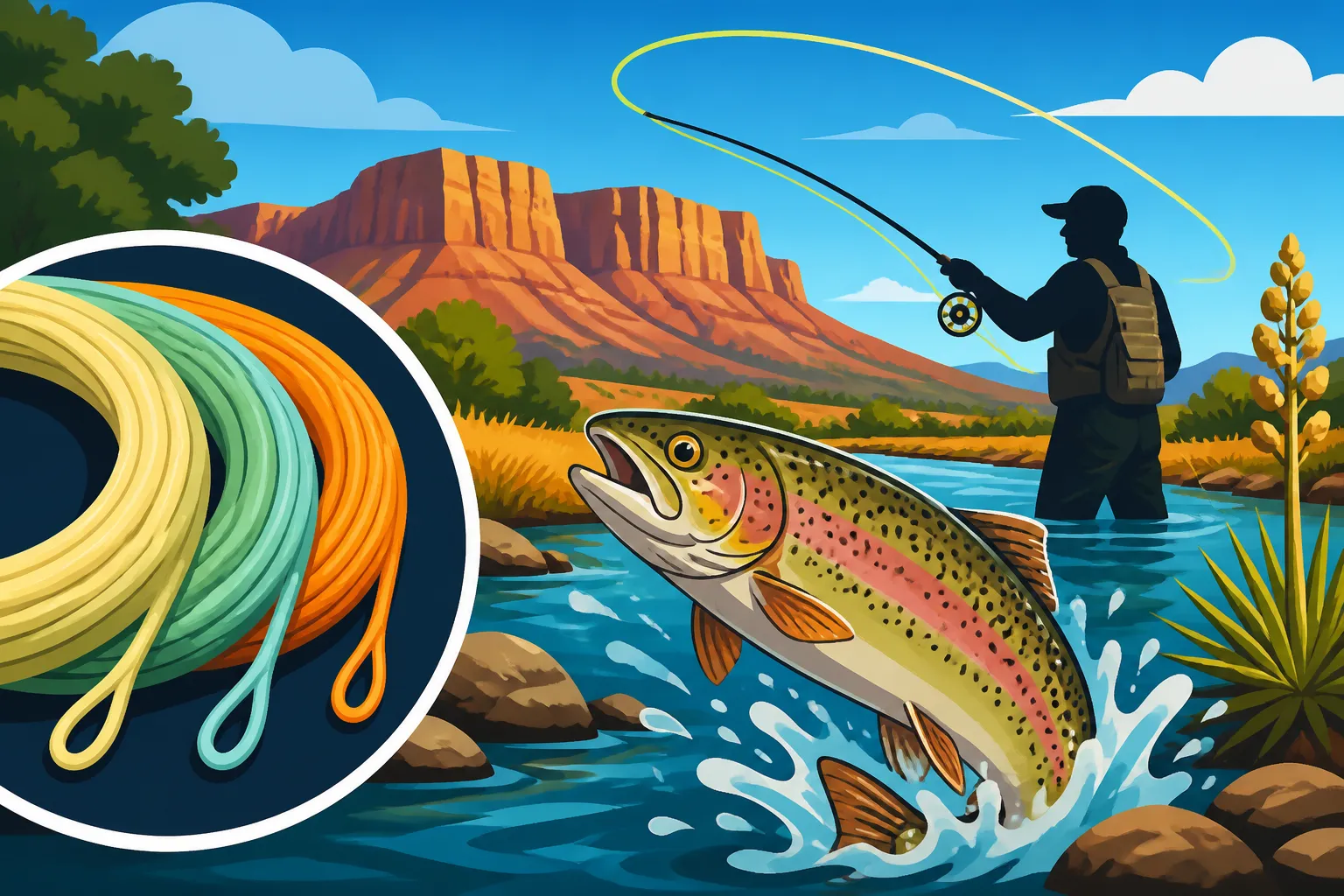
Fly line color might seem purely aesthetic, but it also plays a role. Brightly colored lines (like chartreuse or orange) are highly visible to the angler, which can be a huge advantage for tracking your line's drift, mending effectively, and detecting subtle strikes, especially when Fishing After Runoff in New Mexico or in low light. This visibility can reduce eye strain and improve reaction time. However, some anglers believe bright lines can potentially spook fish, particularly in very clear, shallow water. For this reason, many companies also offer muted or "stealth" colors (like olive, grey, or clear) that are less visible to fish. While the jury is out on how much fish actually "see" the line above the water, some prefer the peace of mind that a camouflaged line provides, especially for sensitive trout in pristine New Mexico waters. Ultimately, the choice often comes down to personal preference and the conditions you frequently fish.
Practical Tips for Choosing and Maintaining Your Fly Line
Choosing the right fly line is a significant step, but it’s only part of the equation. Knowing how to match it to your rod, where to find good options, and how to care for it will ensure your investment pays off with many successful days on New Mexico's waters.
Considering Your Rod's Action and Power
Your fly rod and fly line are a system, and they need to work in harmony. Matching your line weight to the rod's designated weight is the fundamental rule, but also consider your rod's action and power. Rod action refers to where the rod bends when casting:
- Fast-action rods bend mostly in the tip. They are powerful, excellent for generating high line speed, casting long distances, and handling wind or large flies. They often perform best with a line that helps load the tip quickly, sometimes even a line that is a half-size heavy (e.g., a 5.5-weight line on a 5-weight fast-action rod, though standard weights work fine too).
- Medium-action rods bend through the upper half to two-thirds of the blank. They offer a good balance of power and feel, making them very versatile for various casting styles and conditions. Many all-around New Mexico trout rods fall into this category, pairing well with their designated line weight.
- Slow-action rods bend deep into the blank, often almost to the handle. They are known for their delicate presentation, smooth casting stroke, and incredible feel, making them ideal for small streams and short, precise casts. These rods truly come alive with their designated line weight, often making lighter lines sing.
Understanding your rod's characteristics will help you fine-tune your line choice. For instance, a very stiff, fast-action 5-weight rod might feel more responsive with a slightly heavier 5-weight line (some brands label them "true to weight" or "slightly overweight") or a line with a more aggressive front taper to help it load. Conversely, a soft, slow-action 3-weight rod will feel overpowered by anything heavier than its specified 3-weight line.
Budget-Friendly Options and When to Upgrade
Fly line can be a significant investment, and it’s easy to feel overwhelmed by the price tags. The good news is that you don't necessarily need the most expensive line on the market to start enjoying New Mexico's trout fishing. For beginners, a mid-range, quality weight-forward floating line will serve you very well. Brands like Scientific Anglers, Rio, Orvis, and Cortland all offer excellent lines at various price points.
You can often find good deals on reliable fly lines at larger sporting goods stores like Bass Pro Shops, or even through online retailers such as Amazon. Look for lines that offer good all-around performance and durability. As you gain experience, you'll start to notice the subtle differences in lines and might want to upgrade to specialty lines for specific techniques or conditions. For instance, if you find yourself constantly struggling to turn over heavy nymph rigs, investing in a line with a more aggressive taper might be your next step. If you're consistently fishing the San Juan River Special Trout Water and want the absolute best in delicate presentation, a premium double-taper or specialized nymphing line could be a game-changer. Think of your initial purchase as a stepping stone; it’s far better to have a good, clean, functional mid-range line than an expensive, neglected one.
Extending the Life of Your Fly Line in New Mexico's Climate
Fly lines are surprisingly durable, but they do require a bit of care to maintain their performance and extend their lifespan, especially given New Mexico's often arid and dusty environment, coupled with intense sunlight. Neglecting your line can lead to it cracking, becoming stiff, or losing its slickness, all of which will hinder your casting and fishing.
- Cleanliness is Key: Dirt, grime, and even fish slime can accumulate on your line, making it sticky and reducing its ability to shoot through your rod guides. Regularly clean your fly line with a soft cloth and a specialized fly line cleaner (available at most fly shops or from brands like Rio or Scientific Anglers). Simply run the line through the cleaner-dampened cloth as you reel it in after a day of fishing. For a deeper clean, you can strip the entire line off your reel into a bucket of warm, soapy water (using mild dish soap), soak it for a bit, then rinse thoroughly and re-apply a line dressing. This should be done a few times a season, or more often if you fish frequently in dusty or silty conditions.
- Protect from Sun and Heat: UV radiation is a fly line's worst enemy. Never leave your fly reel or line exposed to direct sunlight for extended periods when not in use, especially in a hot car. High temperatures can cause the line to prematurely degrade, crack, and become brittle. Store your fly reels in a cool, dark place when not fishing.
- Inspect for Damage: Before each outing, quickly inspect your line for nicks, cuts, or cracks, particularly in the first 10-20 feet where it sees the most wear. Small imperfections can weaken the line or cause it to snag in your guides. If you find significant damage, it might be time for a new line or, if the damage is only at the tip, you can sometimes cut back a few feet, though this will affect the taper.
- Avoid Kinks: Try to avoid severe kinks or twists in your line, as these can permanently weaken the core and affect casting performance. When storing, ensure your line isn't tightly wrapped around anything small in diameter.
By following these simple care tips, your fly line will remain supple, slick, and capable of delivering those perfect casts for many seasons of New Mexico trout fishing.
| Fly Line Weight (WT) | Typical Trout Size (NM) | Ideal New Mexico Waters (Examples) | Key Advantages | Common Disadvantages |
|---|---|---|---|---|
| 0-2 WT | Small (6-12 inches) | Tiny high-mountain streams, clear spring creeks | Ultra-delicate presentation, minimal splash | Difficult in wind, limited casting distance, no large flies |
| 3-4 WT | Small to Medium (8-16 inches) | Small-to-medium mountain streams, clear rivers | Delicate presentation, good for dry flies & small nymphs | Struggles in strong wind, limited for heavy rigs |
| 5-6 WT | Medium to Large (12-24+ inches) | San Juan River, Pecos River, stocked lakes, larger streams | Most versatile, all-around performance, handles varied flies | Can be too heavy for tiny creeks, not ideal for huge streamers |
| 7-8 WT | Large to Trophy (18-30+ inches) | Eagle Nest Lake, Heron Lake, deep San Juan runs, windy reservoirs | Power for distance & wind, handles large flies/streamers, fighting big fish | Overkill for small streams, less delicate presentation |
Disclaimer
This article is for general informational purposes only and does not constitute professional advice. Laws, prices and regulations vary by location and change over time. Consult a qualified professional for guidance on your specific situation.