Best Kayak Length for Reservoir Fishing
Choosing the right kayak for reservoir fishing in New Mexico can feel like a real puzzle. You're trying to balance stability for standing up and casting, speed to cover those vast waters, and maneuverability to navigate tight coves or submerged structures. It's a common frustration to buy a kayak only to find it's either a sluggish barge on open water or a tippy nightmare when you try to cast. This guide is here to help you navigate the nuances of kayak length so you can pick the perfect vessel to match your angling style and the unique characteristics of New Mexico's diverse reservoirs.
Understanding the Kayak Length Spectrum for Fishing
When we talk about kayak length, it’s not just about how long the boat is from bow to stern; it's about what that length does for your fishing experience. Every inch added or subtracted changes the dynamics of how the kayak performs on the water, impacting everything from your paddle stroke efficiency to how much gear you can carry. It's truly a game of trade-offs, and understanding these will be key to making an informed decision.
Shorter Kayaks: Agility and Accessibility
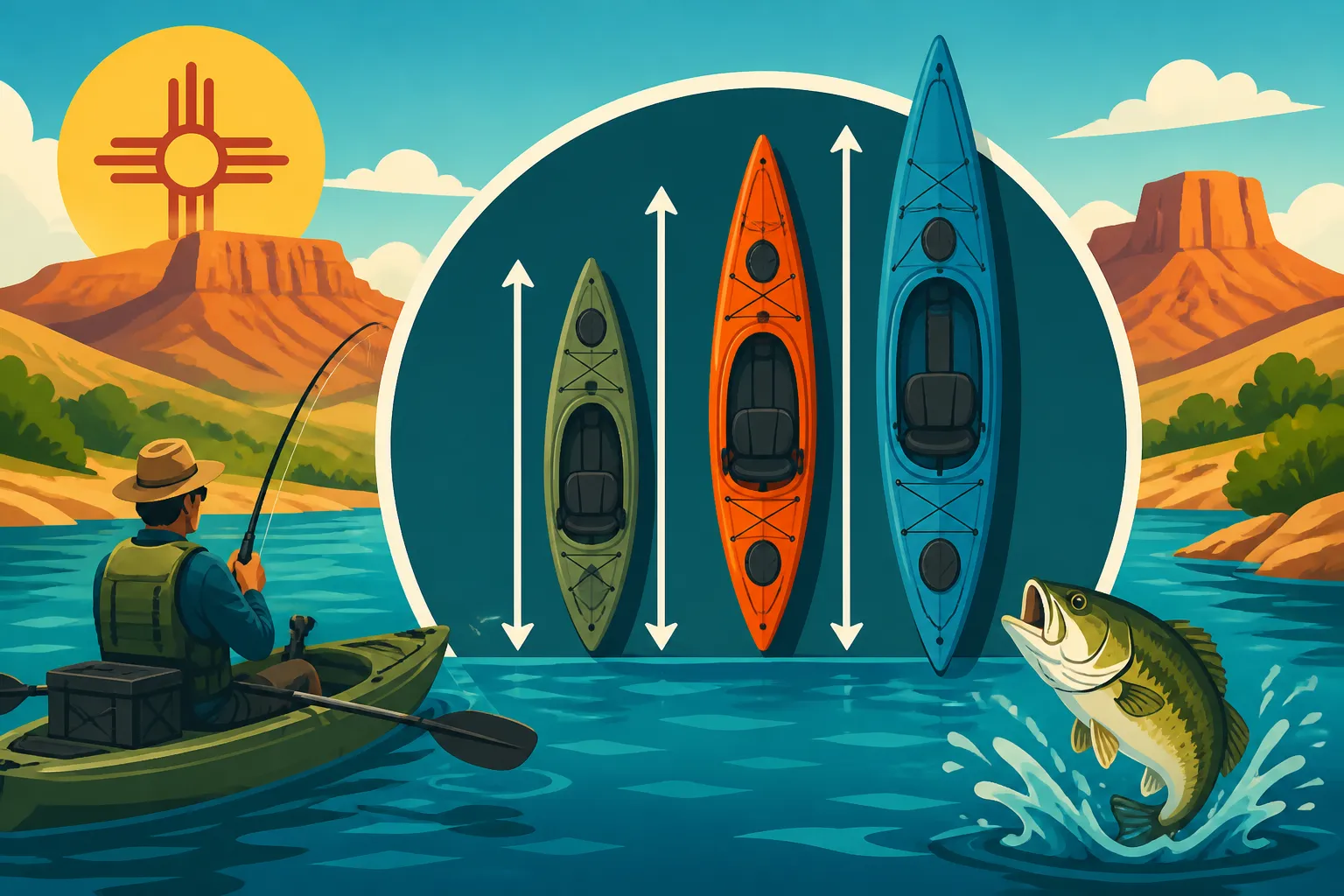
Shorter fishing kayaks, generally those under 11 feet, are often the go-to for anglers who prioritize maneuverability and ease of transport. Think about those hidden coves at places like Cochiti Lake or the more intimate sections of smaller reservoirs. A shorter kayak allows you to turn on a dime, slip into tight spots where bigger boats can't go, and explore every nook and cranny. They're also typically lighter, making them easier to load onto a car roof or carry down to the water's edge, which is a huge plus if you're hitting lesser-known spots without developed boat ramps.
However, this agility comes with some compromises. Shorter kayaks tend to track less efficiently in a straight line, meaning you might find yourself correcting your paddle stroke more often, especially in windy conditions. Covering long distances across a large body of water like Elephant Butte Lake or Navajo Lake can become a real workout, and you'll likely feel the effects of waves and chop more significantly. If your fishing typically involves staying in one general area, or if you're frequently changing locations that require portaging or tight access, a shorter kayak could be your best friend. They also often provide a very stable platform for their size, but don't expect the same initial stability as their longer counterparts, especially if you're hoping to stand and cast.
Medium-Length Kayaks: The Versatile All-Rounders
For many New Mexico reservoir anglers, a medium-length kayak—typically ranging from 11 to 13 feet—strikes the perfect balance. These kayaks offer a much-improved blend of speed, tracking, and maneuverability compared to their shorter siblings. If you're tackling a variety of waters, from the broad expanses of Ute Lake to the winding arms of Conchas Lake, a medium-length kayak can adapt beautifully. They hold a line better, which reduces paddling fatigue on longer retrieves or when crossing open water, and they can handle a bit more chop without feeling overly squirrelly.
The extra length also usually translates to more storage space, allowing you to bring along more gear, a bigger cooler, or even an extra tackle box without feeling cramped. This is crucial for a full day out on the water. Many fishing-specific models in this length range are designed with standing platforms and enhanced stability, making them viable options for sight-fishing or casting heavy lures with greater leverage. While they are heavier than shorter kayaks, they're generally still manageable for a single person to load and unload, especially with the aid of a cart or roof rack assist. For many, this middle ground offers the most practical solution for diverse New Mexico fishing conditions, providing enough performance for open water while still being nimble enough for exploration. You can often find a good range of these versatile kayaks at retailers like Bass Pro Shops or online at Amazon.
Longer Kayaks: Speed, Tracking, and Gear Capacity
When you start looking at kayaks 13 feet and longer, you're entering the realm of serious open-water performance. These are the kayaks for anglers who frequently cover significant distances, whether it's chasing schooling fish across Elephant Butte or trolling for kokanee salmon on Navajo Lake. The increased waterline length of these kayaks translates directly into superior speed and tracking. They cut through the water with less effort, making long-distance paddles far more efficient and less tiring. They also handle wind and waves much better, providing a more stable and predictable ride in challenging conditions.
The trade-off, as you might guess, is maneuverability and portability. Turning a longer kayak in tight spaces, like narrow canyons or crowded boat ramps, requires more effort and space. They are also considerably heavier and bulkier, making transport and storage a more significant challenge. You'll likely need a dedicated trailer or a robust roof rack system, and loading and unloading will often require two people or specialized equipment. However, for those extended trips or when maximum gear capacity is a must – perhaps for an overnight camping and fishing excursion – the extra length really pays off. You'll find ample storage, often multiple hatches, and a more comfortable deck layout for a full day of fishing. While they might not be ideal for every small pond, for the vast reservoirs of New Mexico, they offer unmatched efficiency and comfort for serious anglers.
Key Factors Influencing Your Kayak Length Decision
Beyond the general characteristics of short, medium, and long kayaks, several specific factors should weigh heavily on your final decision. Your fishing style, the types of waters you frequent, and your personal logistics will all play a crucial role in determining what "best" truly means for you.
Type of Fishing and Water Conditions
Consider the kind of fishing you do most often. Are you primarily casting to visible structure along shorelines? Or are you focused on trolling open water or drifting large flats?
- Shoreline & Structure Fishing: If you're constantly working shorelines, pitching lures into submerged timber, or poking around rocky points, a shorter or medium-length kayak will give you the maneuverability to get into those tight spots and quickly adjust your position. On smaller, more intimate waters like Fenton Lake or many of the high mountain lakes, the agility of a shorter kayak is a distinct advantage. You want to be able to spin around and make that perfect cast without fighting the boat.
- Open Water & Trolling: For covering vast open expanses, like the middle of Elephant Butte Lake or Heron Lake, a longer kayak's superior tracking and speed will save you immense effort. When trolling for walleye or salmon, maintaining a consistent speed and straight line is critical, and longer kayaks excel at this. They are less susceptible to being blown off course by the notorious New Mexico winds, making your fishing much more productive and less frustrating. When considering a kayak for these larger waters, think about Best Kayaks for Elephant Butte Lake or Best Boats for Conchas Lake.
- Standing and Sight Fishing: Many modern fishing kayaks are designed for standing, offering a higher vantage point for sight fishing. While some shorter, wider models can be surprisingly stable for standing, longer kayaks generally offer a more confidence-inspiring and less fatiguing standing platform. The increased length provides a more stable keel line, reducing rocking and making it easier to maintain balance, especially when casting. This is particularly beneficial on clear New Mexico waters where spotting cruising fish is part of the game.
Storage and Transportation Logistics
This is a practical concern that often gets overlooked in the excitement of choosing a new boat. A fantastic fishing kayak is useless if you can't easily get it to the water or store it at home.
- Vehicle Compatibility: How will you transport your kayak? If you have a smaller car, a shorter, lighter kayak might be your only option for roof-top transport. Longer kayaks often require a truck bed extender, a dedicated kayak trailer, or a very sturdy roof rack setup. Think about the loading and unloading process – can you manage it alone, or will you always need a buddy? This impacts how often you'll actually get out on the water.
- Home Storage: Do you have space in your garage, shed, or yard for a long kayak? A 14-foot kayak takes up a considerable amount of real estate. Shorter kayaks are much easier to hang on a garage wall or tuck into a corner. Before committing to a length, literally measure out the space you have available. It's a common regret to buy a boat that's a struggle to store.
Stability vs. Speed: Your Personal Preference
This is perhaps the most fundamental trade-off. Generally speaking, a wider kayak offers more initial stability but sacrifices speed. Length also plays a role: a longer kayak, even if it's narrower, often has better secondary stability (how resistant it is to capsizing once it starts to tilt) and significantly better tracking and speed.
- Prioritizing Stability: If your primary concern is feeling rock-solid on the water, especially if you plan to stand a lot, or if you're new to kayaking, you might lean towards a shorter, wider boat or a longer boat with a very stable hull design. This is especially true for Kayak Fishing Gear for New Mexico Lakes beginners. You don't want to spend your entire trip feeling nervous about tipping over.
- Prioritizing Speed and Efficiency: If you're an experienced paddler, or if you plan to cover long distances to reach distant fishing grounds, you'll appreciate the speed and efficiency of a longer, often narrower kayak. These kayaks require less effort to paddle and maintain momentum, making for a much more enjoyable experience on big water. They excel at applications like Trolling Techniques for New Mexico Lakes.
Ultimately, the best kayak length isn't a single number; it's a range that aligns with your specific needs and priorities as a New Mexico angler.
Matching Kayak Length to New Mexico's Reservoirs
New Mexico boasts a diverse array of reservoirs, each with its own character and challenges. The "best" kayak length can truly depend on which waters you frequent most often. Let's break down how different lengths might fare across some popular spots.
Large, Open Water Reservoirs
For the true giants like Elephant Butte Lake, Navajo Lake, and Ute Lake, where you'll often encounter vast open water, significant wind, and potentially choppy conditions, longer kayaks (12.5 feet and up) truly shine.
- Elephant Butte Lake: This reservoir is massive, known for its strong winds and chop, especially in the afternoons. A longer kayak (13-15 feet) will provide the necessary speed to reach distant fishing spots without exhausting yourself and offer much better tracking in a crosswind. The added length helps cut through waves rather than being tossed by them. If you're targeting striped bass or walleye, you'll often need to cover ground, and the efficiency of a longer kayak is invaluable.
- Navajo Lake: While it has some protected coves, Navajo Lake also features large open sections, particularly on the main body. Trolling for kokanee salmon is a popular activity here, and a longer kayak helps maintain a consistent trolling speed and direction. The stability of a longer kayak is also a benefit when you're managing downriggers or multiple rod holders, which is common for Kokanee at Navajo Lake.
- Ute Lake: Similar to Elephant Butte, Ute Lake can get very windy. A longer kayak will give you the peace of mind to venture further from the launch point and still make it back efficiently, even if conditions kick up. It also provides more deck space for coolers and gear needed for a long day on the water.
Medium-Sized and Varied Reservoirs
Many New Mexico reservoirs offer a mix of open water and more protected coves, making them ideal for the versatile medium-length kayaks (11-13 feet). These lakes include Conchas Lake, Heron Lake, and Santa Rosa Lake.
- Conchas Lake: This lake is famous for its intricate arms and coves, but also has sizable open water sections. A 12-foot kayak would be an excellent choice here. It's long enough to paddle efficiently across the open main lake to reach those prime crappie or walleye spots, yet still maneuverable enough to explore the endless coves and flooded timber where bass might be hiding. Conchas Lake Crappie Fishing and Conchas Lake Walleye Fishing are popular targets.
- Heron Lake: Known for its kokanee salmon and trout, Heron Lake has a "no-wake" restriction on much of its surface, making it excellent for paddle craft. A medium-length kayak (11-12 feet) is often perfect here, offering good speed for exploring the lake's various arms and sufficient stability for managing fishing lines. Its moderate size makes it easier to launch at different points around the lake.
- Santa Rosa Lake: With its clear water and rocky structures, Santa Rosa Lake is a great bass and walleye fishery. An 11-12 foot kayak would handle the smaller open areas well while still providing the agility to fish tight to the rocks and submerged cover.
Smaller Lakes and Ponds
For intimate waters like Storrie Lake, Bill Evans Lake, or the numerous urban ponds stocked with trout, shorter kayaks (under 11 feet) are often the most practical and enjoyable choice.
- Fenton Lake: As a smaller, high-mountain lake, Fenton Lake is ideal for shorter, more maneuverable kayaks. The focus here is often on trout, and you'll likely be working shorelines or drifting short distances. A 10-foot kayak is easy to transport to these often remote locations and provides plenty of stability for focused casting.
- Bill Evans Lake: This smaller lake is known for its trout and bass. A shorter kayak offers ample maneuverability to explore all the nooks and crannies of the lake's shoreline. Ease of transport to and from the lake is often a bigger consideration than pure speed on such compact waters.
- Urban Ponds (e.g., Tingley Beach, Percha Dam State Park): For these easily accessible, often stocked ponds, a compact kayak (8-10 feet) is ideal. They're simple to launch and retrieve, perfect for a quick fishing trip, and incredibly easy to store. You won't need to cover vast distances, so maneuverability and ease of use are paramount.
The table below offers a general comparison to help visualize the trade-offs:
| Kayak Length Range | Typical Characteristics | Best for New Mexico Waters | Common Target Species | Pros | Cons |
|---|---|---|---|---|---|
| Short (Under 11 ft) | Highly agile, good stability for size, slower | Small lakes, urban ponds, tight coves (Fenton Lake, Storrie Lake, smaller coves of Cochiti Lake) | Trout, Panfish, Bass (in tight cover) | Easy to transport/store, highly maneuverable, often lighter | Slower, poor tracking on open water, more affected by wind/waves |
| Medium (11-13 ft) | Balanced speed/tracking/maneuverability, versatile | Medium to large reservoirs with varied conditions (Conchas Lake, Heron Lake, Santa Rosa Lake, parts of Navajo Lake) | Bass, Walleye, Trout, Kokanee Salmon | Good all-rounder, decent speed & stability, moderate gear capacity | Less nimble than short, not as fast/stable as long, heavier |
| Long (13+ ft) | Fast, excellent tracking, high gear capacity, very stable | Large, open-water reservoirs (Elephant Butte Lake, Navajo Lake, Ute Lake) | Striped Bass, Walleye, Kokanee Salmon, Catfish | Efficient for long distances, handles chop well, maximum storage | Difficult to transport/store, less maneuverable in tight spots, heavy |
Remember, this is a general guideline. Your personal paddling ability, physical strength, and specific gear needs will also factor into your ideal choice. Don't be afraid to try different kayaks if possible, perhaps by renting one for a day, to get a real feel for what works for you on the water. Before you hit the water, always ensure you're up to date on New Mexico Boat Registration and Titling Guide and other safety regulations.
Practical Considerations Beyond Length
While kayak length is a critical decision point, there are other important features and factors that go hand-in-hand with it to create the ultimate fishing platform for New Mexico. Thinking about these aspects in conjunction with length will help you make a truly informed choice.
Hull Design and Width
Kayak length and hull design are intrinsically linked. A longer kayak with a narrow, V-shaped hull will be fast but less initially stable, whereas a shorter, wider kayak with a flatter hull will be very stable but slow. Fishing kayaks often feature hybrid hull designs, sometimes with a pronounced keel for tracking and chines for stability.
- Stability for Standing: If standing to fish is a priority, look for a kayak that explicitly mentions "standing platform" or "extreme stability" in its description. These often have wider beams and specific hull shapes that prioritize initial stability. This might mean sacrificing a little speed, but it's worth it for the added comfort and casting advantage.
- Tracking and Speed: For covering open water, a longer kayak with a more streamlined hull will perform better. Some kayaks incorporate a rudder system, which, especially on longer boats, can dramatically improve tracking in windy conditions and aid in steering without constantly relying on paddle strokes. This can be a game-changer on lakes like Elephant Butte where crosswinds are common.
Weight and Material
The weight of your kayak is directly impacted by its length and the material it's made from. This, in turn, heavily influences transportation and launch.
- Polyethylene: Most fishing kayaks are made from polyethylene, a durable and affordable plastic. It's tough, able to withstand bumps and scrapes, but it's also heavier. Longer polyethylene kayaks can weigh well over 80-100 pounds, making solo loading and unloading a significant challenge.
- Thermoformed ABS/Composite: Lighter-weight materials like thermoformed ABS or composite blends are available, but they come at a higher price. These kayaks offer a better stiffness-to-weight ratio, meaning they can be lighter for a given length and often paddle more efficiently. If you frequently load your kayak alone or hike into less accessible spots, the weight savings can be worth the investment.
- Inflatables: While not traditional rigid kayaks, high-pressure inflatable kayaks have come a long way. They are incredibly portable and can offer surprising stability. Their major downside for reservoir fishing in New Mexico might be tracking in strong winds compared to rigid boats, and they can be slower. However, for sheer ease of transport and storage, especially if space is a major constraint, they are worth considering, particularly for smaller, calmer waters.
Outfitting and Rigging Considerations
The internal setup and potential for customization are just as important as the kayak's physical dimensions.
- Storage: Longer kayaks naturally offer more internal storage hatches and deck space for crates or bags. Consider how much gear you typically bring. Do you need space for a large tackle bag, a cooler, a dry bag for electronics, and maybe a small anchor? Check for dedicated areas like tankwells, bow/stern hatches, and side pockets.
- Rod Holders: Most fishing kayaks come with flush-mount rod holders, but consider how many you'll need and if there's space for aftermarket additions like track-mounted rod holders. If you plan to troll with multiple rods, or simply want to keep extra rods handy and secure, evaluate the existing rigging options. Best Rod Holders for Boat Fishing New Mexico Lakes can make a huge difference in your fishing comfort and efficiency.
- Electronics Mounting: Do you plan to add a fish finder or GPS? Look for flat surfaces, gear tracks, or pre-installed inserts that make mounting electronics easy. Longer kayaks generally provide more flexible options for placement and battery storage. When considering a fish finder, think about Best Fish Finders for New Mexico Reservoirs for those deep New Mexico waters.
- Comfort: The seat is paramount. A comfortable seat, especially on a longer kayak where you'll be spending extended hours, can make or break your trip. Look for adjustable, elevated seats with good back support. Some seats are even designed for easy removal for use on shore.
Ultimately, the best kayak length for reservoir fishing in New Mexico is a personal choice that balances your fishing aspirations with practical realities. By carefully considering these factors, you can select a kayak that will provide years of enjoyable and productive angling adventures on the Land of Enchantment's beautiful waters.
Disclaimer
This article is for general informational purposes only and does not constitute professional advice. Laws, prices and regulations vary by location and change over time. Consult a qualified professional for guidance on your specific situation.