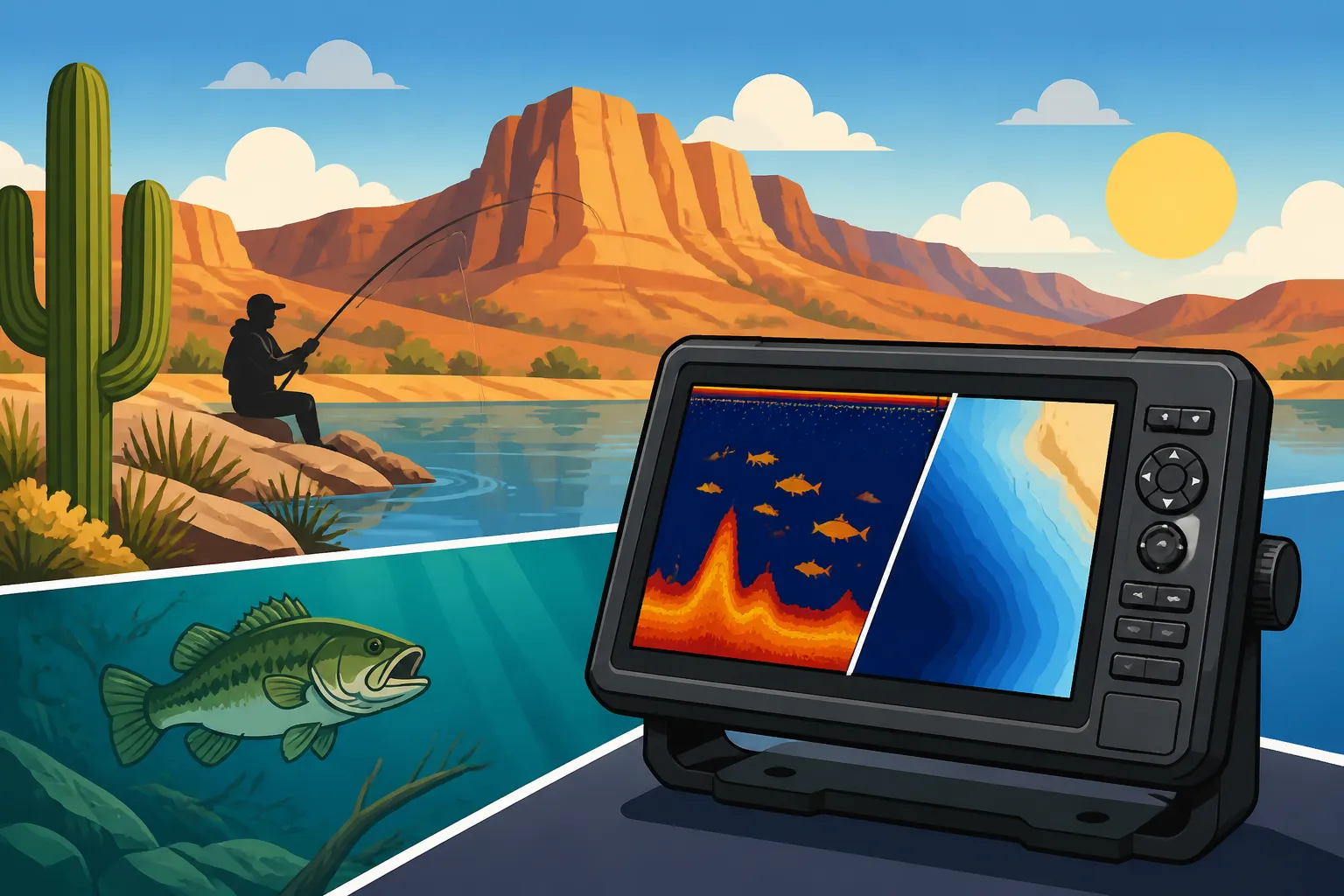
Best Fish Finders for New Mexico Reservoirs
There's nothing quite as frustrating as pulling up to a vast New Mexico reservoir, gazing out over those beautiful, sparkling waters, and feeling completely lost about where the fish might be hiding. You've got your boat, your rods, your bait, but without a clue as to what's beneath the surface, it often feels like you're just casting into the void. This comprehensive guide is here to equip you with the knowledge to choose and use the best fish finders for New Mexico's diverse lakes, turning those frustrating guesses into confident casts.
Why a Fish Finder is a Game-Changer for New Mexico Anglers
Let's be real, New Mexico's reservoirs aren't small farm ponds. Places like Elephant Butte, Navajo Lake, and Conchas Lake are massive bodies of water, often with complex underwater topography. Trying to find fish here without a fish finder is like looking for a needle in a haystack – you might get lucky, but the odds are definitely stacked against you. A good fish finder transforms your fishing experience from a hopeful gamble into a strategic hunt, giving you a clear advantage by showing you what's happening beneath your boat.
Navigating Diverse Reservoir Environments
New Mexico's lakes are incredibly varied, from the deep, sprawling expanses of Elephant Butte to the more modest depths of places like Ute Lake. Each reservoir presents its own unique challenges, whether it's understanding vast open water, navigating submerged canyons, or locating structure in murky conditions. A fish finder doesn't just show you fish; it shows you the entire underwater landscape. This means you can identify drop-offs, humps, old river channels, and even subtle changes in bottom composition that are invisible from the surface. Without this crucial insight, you're essentially blind to the underwater world that dictates where fish will hold.
Think about trying to troll for walleye across a huge flat. You could spend hours covering water without a bite. But with a fish finder, you might quickly see a submerged ridge or a thermocline where fish are actively feeding. Or perhaps you're exploring a new area on Navajo Lake Fishing Guide, and you suddenly spot a massive school of kokanee salmon suspended at 40 feet. This kind of real-time information drastically reduces wasted time and fuel, allowing you to focus your efforts where they're most likely to pay off. It turns a vast, intimidating body of water into a series of identifiable, fishable zones.
Uncovering Hidden Structure and Cover
Fish are creatures of habit and comfort, and that comfort often comes in the form of structure and cover. In New Mexico's reservoirs, this can mean anything from old flooded timber and rock piles to submerged brush, ledges, and even artificial fish habitats that have been placed over the years. These are the places where baitfish congregate, and consequently, where larger predatory fish like bass, walleye, and stripers will lurk, waiting for an ambush. From the surface, most of this prime real estate is completely invisible.
Imagine pulling up to a seemingly barren shoreline on Elephant Butte Lake Fishing Guide, only for your fish finder to reveal a dense, submerged cedar tree just 20 feet from your boat, absolutely teeming with crappie. Or perhaps you're targeting big smallmouth bass and your sonar picks up a massive rock pile at the base of a sharp drop-off that you'd never have known was there. These hidden gems are often untouched by other anglers precisely because they can't be seen. A quality fish finder, especially one with advanced imaging capabilities, allows you to pinpoint these key areas, understand their layout, and present your lure with precision, greatly increasing your chances of a successful hook-up.
Understanding the Different Types of Fish Finders
When you start looking at fish finders, the terminology can feel a bit overwhelming, almost like learning a new language. But fear not, each type of sonar technology has a specific purpose, and understanding the basics will help you choose the right tool for your New Mexico adventures. It's not about having all the features, but having the right features for how and where you fish.
Traditional 2D Sonar and Down Imaging
Traditional 2D sonar is the classic "fish arch" display that most people picture when they think of a fish finder. It sends a conical beam straight down and displays returns as arches (fish) or lines (bottom structure). It's excellent for showing you what's directly beneath your boat and identifying fish that pass through its beam. For many anglers, especially those just starting out or working with a tighter budget, a good 2D sonar is more than sufficient for finding fish and basic structure. It's tried, true, and effective.
Down Imaging (often called DownScan or ClearVü by different brands) takes traditional 2D sonar a step further by using a much thinner, high-frequency beam to create a picture-like view of what's directly below your boat. Instead of arches, you'll see actual representations of submerged trees, rocks, and even fish in incredible detail, almost like an X-ray of the bottom. This technology is fantastic for distinguishing between a submerged log and a school of baitfish, or for identifying the specific type of structure you're casting to. When you're trying to pick apart a complex brush pile for crappie or bass in Conchas Lake Fishing Guide, Down Imaging can be a real lifesaver, making it easier to see exactly where those fish are holding within the cover.
Side Imaging and 360 Sonar
Now we're moving into the realm of truly advanced fish-finding. Side Imaging (or SideScan, SideVü) is like having sonar eyes on the sides of your boat. It sends out beams to the left and right, creating a photographic-quality image of the bottom and structure up to several hundred feet away from your boat. This is an absolute game-changer for covering vast areas quickly and finding hidden structure that you might have otherwise driven right over. Imagine motoring down a shoreline, and suddenly your screen shows an old submerged road bed 50 feet to your left, complete with fish holding right on its edge. This capability means you spend less time searching and more time fishing.
For New Mexico's larger reservoirs, where you're often exploring expansive areas for Walleye Fishing in New Mexico or targeting schools of Striped Bass Fishing in New Mexico in open water, Side Imaging allows you to scan incredible amounts of water in a short period. You can easily identify entire networks of underwater features that would take days to map with traditional sonar. Then there's 360 Sonar, which offers an even more comprehensive view, creating a full circle, bird's-eye image around your boat. While specialized and often a higher investment, it gives you unparalleled awareness of your immediate surroundings, particularly useful for staying on top of schools of fish or mapping out complex underwater structures in real-time without constantly moving your boat.
CHIRP Sonar Technology
CHIRP stands for "Compressed High-Intensity Radiated Pulse," and it's a technology that significantly enhances both 2D and imaging sonars. Instead of sending out a single frequency pulse like traditional sonar, CHIRP sends a continuous sweep of frequencies (from low to high) in each pulse. This allows the receiver to process a much wider range of information, resulting in several key advantages:
Firstly, CHIRP provides much better target separation. This means if you have a school of fish tightly packed together, CHIRP can differentiate individual fish within that school, whereas traditional sonar might just show a big blob. This is crucial when you're trying to figure out if you're looking at a single trophy fish or just a dense school of bait. Secondly, it offers superior clarity and detail at all depths, cutting through noise and providing a clearer image of both fish and structure. Lastly, CHIRP can often penetrate deeper with less power, and it's less prone to interference from other transducers or boat electronics. Most modern fish finders, whether from a brand like Humminbird, Lowrance, or Garmin, now incorporate CHIRP into their 2D and imaging technologies, making it a standard for high-performance units. If you're serious about your fishing, especially in the deeper, clearer waters of New Mexico's high-country lakes, CHIRP is a feature you absolutely want.
Essential Features to Look for in a New Mexico Reservoir Fish Finder
Choosing a fish finder isn't just about picking the most expensive one; it's about matching the features to your specific needs and the unique conditions of New Mexico's waters. Just like you wouldn't use a fly rod for deep-sea fishing, you want a fish finder that's optimized for the kind of angling you'll be doing.
Screen Size and Resolution
This might seem obvious, but it's incredibly important. You can have the most advanced sonar technology in the world, but if you can't clearly see and interpret what's on the screen, it's not doing you much good. Screen size directly impacts how much information you can display simultaneously and how easy it is to distinguish details. For serious anglers spending a lot of time on the water, a screen of 7 inches or larger is often recommended. This allows you to split the screen to view 2D sonar, Down Imaging, and a GPS map all at once without squinting.
Resolution, measured in pixels, determines the clarity and sharpness of the image. Higher resolution screens will display more detail, making it easier to differentiate a fish from a piece of brush or to follow subtle contour lines on your map. Imagine trying to identify a single kokanee salmon in a dense school on a low-resolution screen versus a high-resolution one – the difference is night and day. Consider how much detail you need and how far away you'll be from the screen. If your unit is mounted at the console and you'll be fishing from the bow, a larger, clearer screen becomes even more critical. You can find excellent options for various screen sizes and resolutions at retailers like Bass Pro Shops or by browsing online on Amazon.
Transducer Power and Frequencies
The transducer is the "eye" of your fish finder, sending and receiving the sonar signals. Its power (measured in watts RMS) and the frequencies it operates at are critical, especially for the deep, expansive reservoirs found throughout New Mexico.
- Power (RMS): More power generally means deeper penetration and better performance at higher speeds. If you're exploring the abyssal depths of Elephant Butte Lake for suspended stripers or searching for structure in very deep water, a higher RMS power output will be beneficial. It ensures a strong enough signal returns to give you a clear reading from the bottom.
- Frequencies: Different frequencies are good for different things:
- Low Frequencies (e.g., 50 kHz): These penetrate deeper and are excellent for deep water applications. They cover a wider area but offer less detail.
- High Frequencies (e.g., 200 kHz, 455 kHz, 800 kHz, 1.2 MHz): These provide much finer detail and better target separation but don't penetrate as deep and cover a narrower cone. They are perfect for identifying individual fish, seeing clear structure, and working in shallower waters.
- CHIRP Frequencies: As discussed, CHIRP sweeps a range of frequencies, offering the best of both worlds by combining depth penetration with excellent detail.
For New Mexico's diverse lakes, a transducer that can operate on multiple frequencies or a CHIRP-enabled transducer is usually the best bet. This versatility allows you to switch between broad, deep scans and highly detailed, shallower views as conditions and your target species change. You might want to use a lower frequency to quickly scan a large area for structure, then switch to a higher frequency or Down Imaging once you've identified a promising spot to get a more detailed look.
GPS, Mapping, and Waypointing
In the vastness of New Mexico's reservoirs, a fish finder without GPS and mapping capabilities is frankly missing half the equation. GPS allows you to know exactly where you are on the water, and mapping lets you visualize the contours, depths, and navigation hazards. But the real power comes from waypointing.
- Waypointing: This feature allows you to mark specific locations on your map. Found a hot fishing spot? Mark it with a waypoint. Spotted a hidden brush pile with fish? Drop a waypoint. Want to remember a particularly tricky navigation hazard? Mark it. Over time, your map will become a personal treasure trove of valuable fishing intelligence. You can return to these spots with pinpoint accuracy, saving you countless hours of searching. This is invaluable when revisiting productive areas for Bass Fishing Techniques for New Mexico Lakes or trying to re-find a deep walleye hump.
- Mapping: Many units come pre-loaded with detailed lake maps (often called "charts"). These charts show depth contours, navigation markers, and sometimes even points of interest. Some higher-end units allow you to create your own custom maps in real-time as you motor along, logging detailed bottom contours and composition. This "genesis mapping" can give you an incredible edge by revealing subtle structure changes that aren't on standard maps, especially in lesser-fished areas of a large lake. Whether you're navigating Ute Lake Fishing or exploring new coves, robust mapping is indispensable.
Tailoring Your Fish Finder Choice to New Mexico's Unique Waters
New Mexico's fishing landscape is a blend of deep, clear mountain lakes, sprawling low-desert reservoirs, and everything in between. The "best" fish finder isn't a one-size-fits-all solution; it truly depends on where you're casting your line and what you're hoping to catch.
Deep Water Exploration (Elephant Butte, Navajo Lake)
When you're plumbing the depths of lakes like Elephant Butte or Navajo Lake, which can easily reach hundreds of feet deep in places, your fish finder needs to be a workhorse. Here, depth penetration and powerful transducers are paramount. You're not just looking for the bottom; you're often searching for suspended schools of fish, like striped bass that might be holding at 60 feet over 100 feet of water, or kokanee salmon suspended in the thermocline.
- High-Power CHIRP Sonar: This is non-negotiable for deep water. The wide range of frequencies and superior target separation will allow you to see fish arches clearly, even when they're deep and scattered. It also helps in identifying bait balls that larger predators are likely to be lurking around.
- Dual-Frequency Transducer: Having the ability to switch between a wider, low-frequency beam for general deep-water scanning and a narrower, high-frequency beam for more detailed views of targets is incredibly useful. This allows you to efficiently scan vast areas and then zoom in on promising returns.
- Side Imaging for Coverage: While primarily for structure, Side Imaging can still be valuable in deep water by quickly scanning wide swaths for large schools of suspended baitfish or defining the edges of deep underwater structures, saving you time from having to drive directly over every potential spot. This is especially true when using Trolling Techniques for New Mexico Lakes.
The biggest challenge in these deep reservoirs is distinguishing actual fish from thermoclines or debris. A quality fish finder with clear resolution and advanced processing helps cut through the clutter, giving you a more accurate picture of the productive zones.
Shallow and Murky Water Challenges (Conchas, Ute Lake)
On the flip side, some New Mexico reservoirs, particularly during certain times of the year or after heavy rains, can present challenges with shallower depths and murkier water. Lakes like Conchas or parts of Ute Lake might have more stained water, which can make sonar signals harder to interpret. Here, different features come to the forefront.
- High-Frequency Imaging (Down and Side): In shallower, murkier conditions, higher frequencies (e.g., 800 kHz or 1.2 MHz) for Down Imaging and Side Imaging become incredibly valuable. These frequencies provide much better detail and clarity in the upper water column and near the bottom, even when water visibility is low. They can cut through some of the murk to reveal submerged timber, weed lines, or rock piles that are prime bass or crappie habitat.
- Adjustable Sensitivity/Noise Rejection: Being able to fine-tune your unit's sensitivity and noise rejection settings is crucial. Murky water, suspended sediment, or even dense plankton blooms can create a lot of "clutter" on your screen. A good unit will allow you to reduce this noise without sacrificing too much detail, helping you to pick out actual fish and structure from the interference.
- Mapping for Navigation: Even in shallower areas, good GPS and detailed mapping are still essential for navigating around submerged hazards and returning to productive spots, especially if visibility above and below the water is compromised.
While deep-penetrating power might not be the top priority here, clarity and detail in the upper water column are what will help you spot those shallow-holding fish.
Targeting Specific Species (Walleye, Bass, Stripers)
Different fish species behave differently and hold in various parts of the water column and structure. Your fish finder choice can be tailored to give you an edge when targeting specific New Mexico favorites.
| Species Targeted | Key Fish Finder Features Recommended | Why It Matters |
|---|---|---|
| Walleye | CHIRP 2D Sonar, Down Imaging, GPS/Mapping, AutoChart Live (if available) | Walleye often hug the bottom or relate to subtle structure. Clear bottom detail and the ability to map contours are critical. AutoChart Live helps find those hidden humps and drops. |
| Largemouth Bass | Side Imaging, Down Imaging, High-Frequency Sonar, GPS/Mapping | Bass are structure-oriented. Side Imaging helps locate submerged brush, timber, and weed lines quickly. Down Imaging provides detailed views of individual fish in cover. |
| Smallmouth Bass | Side Imaging, CHIRP 2D Sonar, High-Resolution Display, GPS/Mapping | Smallmouth prefer rocky areas, ledges, and breaks. Side Imaging excels at mapping rocky bottom, and high-resolution helps pick out camouflaged fish. |
| Striped Bass | Powerful CHIRP 2D Sonar, Large Screen, High-Resolution Display | Stripers often suspend in open water or chase baitfish. Strong deep-water penetration and the ability to clearly see suspended schools are key. |
| Trout (Lake/Suspended) | CHIRP 2D Sonar, High-Resolution Display | Lake trout and suspended rainbows can be found at specific depths. Clear arches and target separation help identify them from baitfish. |
| Crappie | Down Imaging, Side Imaging, High-Frequency Sonar, Large Screen | Crappie often stack in brush piles or around vertical structure. Detailed imaging is crucial to seeing individual fish within the cover. |
For instance, if your passion is chasing big Largemouth Bass Fishing in New Mexico, you'll want excellent Side Imaging to scout out submerged timber and weed lines. If you're a devoted walleye angler, sharp Down Imaging and accurate mapping for those subtle humps and breaks will be your best friend. Meanwhile, for those massive schools of striped bass in the main lake basins, powerful 2D CHIRP sonar with a wide cone angle is essential for finding them in open water.
Installation, Operation, and Maintenance Tips
Getting the right fish finder is only half the battle. Proper installation, knowing how to operate it effectively, and keeping it well-maintained are crucial for getting the most out of your investment and ensuring it serves you faithfully on countless New Mexico fishing trips.
Mounting Your Transducer and Display
This might sound like a simple step, but transducer placement is absolutely critical for optimal performance. An improperly mounted transducer will give you bad readings, no matter how expensive your fish finder is.
- Transducer Placement: The goal is to get the transducer into "clean" water, meaning water that isn't turbulent or full of air bubbles from your boat's hull or motor.
- Transom Mount: The most common and easiest method for smaller boats. Mount it on the transom, slightly off-center and away from props, ensuring it's below the hull line but not so deep it creates excessive drag. Adjust it so it's level when the boat is on plane.
- Through-Hull Mount: For more permanent installations, particularly on larger boats or those with stepped hulls, a through-hull transducer offers superior performance as it's always in clean water. However, it requires drilling a hole in the hull.
- Trolling Motor Mount: Many transducers are designed to be mounted directly to your trolling motor, which is excellent for getting clear readings while slowly moving or when spot-locked.
- Wiring: Route all cables carefully, avoiding sharp bends, pinching, or running them alongside high-voltage electrical wires, which can cause interference. Use marine-grade connectors and seal any exposed connections to prevent moisture intrusion.
- Display Unit: Mount your display unit in a spot that's easily visible from your usual fishing position, but also protected from direct sunlight and the elements. A strong, stable mount is essential, especially when bouncing across choppy water on Elephant Butte Lake. Consider a RAM Mount or similar robust system for adjustability and security.
If you're not comfortable with the installation yourself, many marine shops at New Mexico's larger lakes or even Bass Pro Shops can handle professional installation, ensuring everything is set up correctly.
Interpreting Sonar Readings Like a Pro
The screen on your fish finder might look like abstract art at first, but with a little practice, you'll start to "read the water" like a seasoned pro. It's not just about seeing arches; it's about understanding what those arches, lines, and colors represent.
- Arches and Fish: Classic 2D sonar displays fish as arches. A full, strong arch indicates a fish that passed through the entire sonar cone. Smaller, broken arches might be smaller fish or fish on the edge of the cone. The thickness and color of the arch (on color screens) can sometimes indicate the size and density of the fish. Remember, these are not live video feeds; they are interpretations of sound waves.
- Bottom Structure: The bottom line itself tells a story. A hard, jagged bottom (rock, timber) will often appear as a thicker, more intense line, sometimes with a "double echo" below it. A soft, muddy bottom will typically be a thinner, less intense line. Irregularities in the bottom line, like humps, drops, or submerged channels, are key areas to target.
- Cover and Thermoclines: Submerged trees, brush piles, or weed beds will appear as distinct shapes with varying density on Down Imaging and Side Imaging screens. Learning to identify these distinct forms is crucial. Thermoclines, which are layers of water at different temperatures, often appear as horizontal lines across your 2D sonar. Fish, especially in summer, will frequently hold along these thermoclines where oxygen levels and baitfish are optimal.
- Gain/Sensitivity Adjustment: This is your most important tool. Too low, and you'll miss fish and structure. Too high, and your screen will be full of clutter. Adjust it frequently based on depth and water conditions. You want it high enough to pick up faint returns, but low enough to avoid excessive noise. This is similar to adjusting your vision when trying to How to Read Water on the San Juan River where subtle changes indicate holding fish.
Practice, practice, practice! Spend time simply driving around, observing what your fish finder shows you over known structure, and comparing it to what you catch. The more time you spend deciphering the screen, the better you'll become at understanding its language.
Keeping Your Unit in Top Condition
A fish finder is an investment, and like any good piece of gear, it needs a little TLC to ensure longevity and reliable performance.
- Cleaning: After each trip, especially in New Mexico's often dusty or muddy conditions, wipe down the screen and unit with a soft, damp cloth. Avoid harsh chemicals or abrasive materials that could scratch the screen. Ensure all connections are clean and free of corrosion.
- Software Updates: Most modern fish finders have software that can be updated. Check the manufacturer's website periodically for updates, which can improve performance, add new features, or fix bugs. This usually involves downloading the update to an SD card and loading it onto your unit.
- Transducer Care: Keep your transducer clean and free of marine growth or debris. A fouled transducer will give poor readings. If you frequently trailer your boat, inspect the transducer for any damage from road debris or bumps.
- Power Supply: Ensure your boat's battery is in good condition and provides consistent power. Voltage drops can affect sonar performance. Also, ensure all electrical connections are tight and corrosion-free.
- Storage: When not in use, especially for extended periods, remove the display unit from your boat and store it in a cool, dry place. Many units come with protective covers; use them! This protects the screen from scratches and the electronics from extreme temperatures and moisture.
By following these tips, your fish finder will be a reliable companion for many years of successful fishing on Best Places to Fish in New Mexico and beyond. Remember, a well-maintained unit is a happy unit, and a happy unit means more fish in the net!
Disclaimer
This article is for general informational purposes only and does not constitute professional advice. Laws, prices and regulations vary by location and change over time. Consult a qualified professional for guidance on your specific situation.